
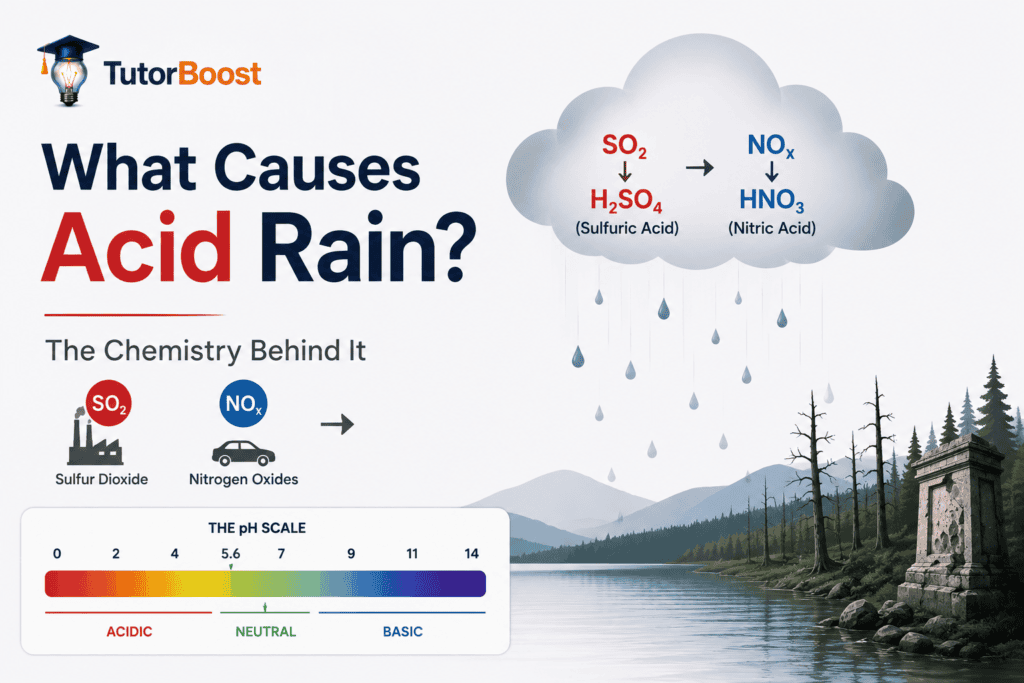
Rain isn’t actually neutral to begin with, so what turns ordinary rain into something that damages lakes, forests, and buildings? The answer lies in real chemical reactions happening high in the atmosphere. At TutorBoost, we break down exactly what causes acid rain and the chemistry behind it, without getting lost in policy debates or vague explanations.
What Is Acid Rain?
Acid rain is precipitation with a pH noticeably lower than normal rain, generally falling below 5.0 and often reaching 4.5 or lower in heavily polluted regions. It falls as rain, snow, fog, or even dry particles, carrying acidity from the atmosphere down to the ground. Scientists often use the broader term “acid deposition” to cover all these forms, not just liquid rainfall.
Why Normal Rain Is Already Slightly Acidic
Before acid rain even enters the picture, ordinary rain is already mildly acidic, sitting around pH 5.6. This happens because rain absorbs dissolved carbon dioxide from the air, forming a weak carbonic acid. It’s a completely natural process and isn’t considered harmful, since carbonic acid is far too weak to cause the damage associated with true acid rain.
What Makes Rain Cross Into “Acid Rain” Territory
Acid rain forms when additional pollutants push that pH even lower, often to 4.5 or below. Unlike the mild carbonic acid in normal rain, acid rain contains much stronger acids, formed from industrial and vehicle emissions rather than natural atmospheric CO2. The difference between pH 5.6 and pH 4.5 might look small on paper, but because the pH scale is logarithmic, it represents more than a tenfold increase in acidity.
What Causes Acid Rain?
Acid rain is caused primarily by two pollutants: sulfur dioxide (SO2) and nitrogen oxides (NOx), both released in large quantities when fossil fuels are burned. These gases don’t cause damage on their own until they undergo further reactions in the atmosphere.
Where Sulfur Dioxide and Nitrogen Oxides Come From
Power plants that burn coal are responsible for the majority of sulfur dioxide emissions, generating roughly two-thirds of the total, while vehicles and industrial facilities contribute heavily to nitrogen oxide levels, accounting for close to a quarter of that total.
These gases can travel hundreds of miles on wind currents before reacting and falling back to Earth, meaning acid rain can affect regions far from its original source. This is why acid rain has historically been a cross-border issue, with emissions from one region falling as acid rain in another.
Can Acid Rain Happen Naturally?
Yes, though to a much smaller extent. Volcanic eruptions release sulfur dioxide directly into the atmosphere, and lightning strikes can produce nitrogen oxides through the same high-temperature reactions that occur inside a car engine. Historically, natural sulfur cycling kept rain acidity in check long before industrial emissions became the dominant factor, allowing ecosystems time to adapt to naturally occurring acid levels.
What’s the Actual Chemistry Behind Acid Rain?
Once released, sulfur dioxide and nitrogen oxides don’t stay unchanged. They undergo specific chemical reactions in the atmosphere that transform them into strong acids, which is the real turning point between ordinary air pollution and acid rain.
How Sulfur Dioxide Becomes Sulfuric Acid?
Sulfur dioxide reacts with water vapor and oxygen in the atmosphere, eventually oxidizing into sulfuric acid. The reaction happens in stages: sulfur dioxide first combines with water to form sulfurous acid, which then oxidizes further into sulfuric acid (SO₂ + H₂O + ½O₂ → H₂SO₄). This is the same sulfuric acid used in car batteries and industrial processes, except here it forms naturally as airborne droplets rather than in a factory. Once formed, sulfuric acid dissolves into rain droplets, dramatically lowering their pH before they ever reach the ground.
How Nitrogen Oxides Become Nitric Acid?
Nitrogen oxides form when nitrogen and oxygen react at high temperatures, such as inside a combustion engine (N₂ + O₂ → 2NO). Nitric oxide (NO) is produced first, which quickly reacts with additional oxygen to form nitrogen dioxide (2NO + O₂ → 2NO₂), the same reddish-brown gas responsible for smog haze.
This then combines with water vapor to produce nitric acid (3NO₂ + H₂O → 2HNO₃ + NO), the second major acid responsible for acid rain.
How Is Acid Rain Measured?
Like any acidic or basic solution, acid rain is measured using the pH scale, the same 0-to-14 scale used for everything from lemon juice to soap. Scientists collect rainwater samples and test them with the same tools used in any chemistry lab, from simple indicator strips to precise digital meters.
Comparing Acid Rain pH to Everyday Substances
Normal rain sits around pH 5.6, while acid rain typically falls between pH 4 and 4.5, sometimes lower in heavily polluted regions. For context, this places acid rain closer to black coffee or tomato juice on the same pH scale used to classify acids and bases throughout chemistry.
Because the scale is logarithmic, even a one-point drop represents a tenfold jump in acidity, which explains why acid rain causes so much more damage than its pH number might suggest at first glance.
What Effects Does Acid Rain Have?
Acid rain doesn’t just fall and disappear. It interacts with ecosystems and human-made structures in ways that compound over time, often taking years before the damage becomes visible.
Impact on Lakes, Forests & Soil
Acid rain gradually lowers the pH of lakes and streams, making the water inhospitable for fish and other aquatic life. In soil, it strips away essential nutrients while releasing naturally occurring aluminum, which is toxic to plant roots and can stunt forest growth. Trees weakened this way also become more vulnerable to disease, insects, and harsh weather.
Impact on Buildings & Structures
Acid rain reacts with materials like marble and limestone, both made largely of calcium carbonate, slowly dissolving surfaces over decades. The acid literally breaks the calcium carbonate apart, converting it into calcium sulfate and carbon dioxide, which washes away with each new rainfall.
This is why many older stone buildings and monuments show visible erosion and pitting in areas historically affected by heavy acid rain, with some historic landmarks requiring extensive restoration as a direct result.
Final Thoughts
Acid rain isn’t just polluted water, it’s the direct result of sulfur dioxide and nitrogen oxides transforming into sulfuric and nitric acid high in the atmosphere. Understanding this chemistry makes the environmental effects far easier to explain.
At TutorBoost, we love connecting real-world science to the chemistry students are already learning. Curious about our approach? Ready to get started? Contact us or make an appointment today.
Frequently Asked Questions
Is all rain slightly acidic?
Yes. Normal rain sits around pH 5.6 due to dissolved carbon dioxide forming weak carbonic acid, which is completely natural and not harmful.
Can acid rain happen without human activity?
Yes, though only to a small degree. Volcanic eruptions and lightning strikes can produce sulfur dioxide and nitrogen oxides naturally, but human fossil fuel combustion is the dominant modern cause.
Does acid rain directly harm humans?
Not through direct contact, but the pollutants that cause it, along with ground-level ozone from nitrogen oxides, can contribute to respiratory issues when inhaled as air pollution.
How is acid rain different from ocean acidification?
Acid rain falls from the atmosphere onto land and freshwater, while ocean acidification happens when oceans absorb excess atmospheric carbon dioxide directly, lowering seawater pH over time.
Can acid rain damage be reversed?
Some ecosystems recover once emissions decrease, as seen in certain lakes and forests following stricter pollution controls, though recovery can take many years depending on the severity of the damage.