
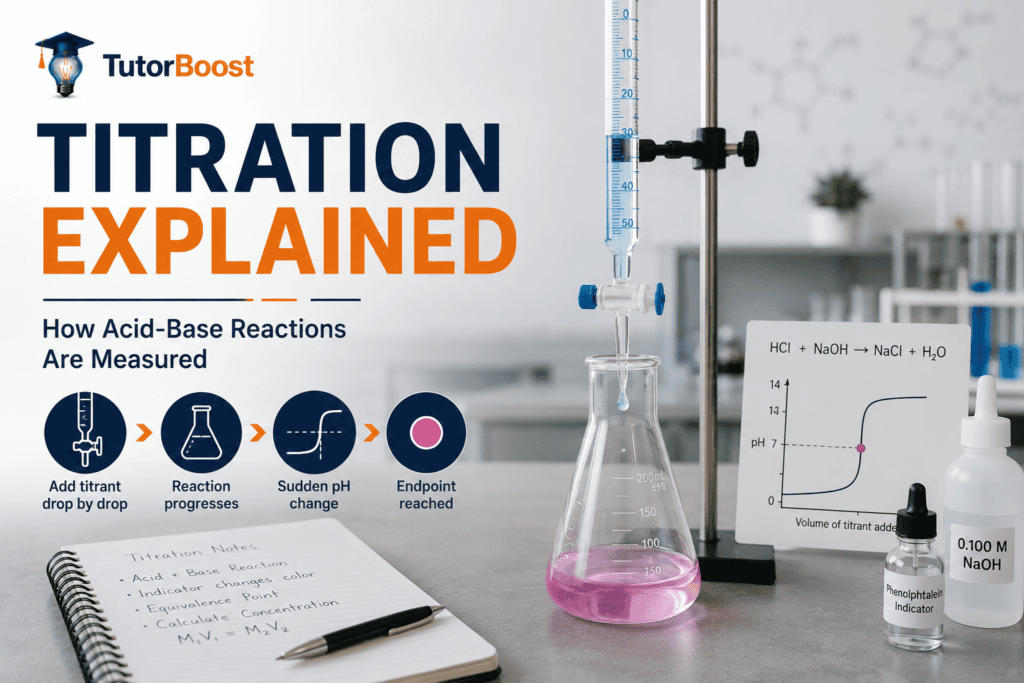
How does a winemaker know exactly how acidic their wine is, or a lab confirm precisely how strong a solution really is? The answer is titration, a technique chemists have relied on for over a century to measure exactly what’s in a solution. At TutorBoost, we break titration down step by step through science tutoring, without the dense formulas that make most explanations harder than they need to be.
What Is Titration?
Titration is a lab technique used to find the exact concentration of an acid or base by reacting it, drop by drop, with a solution of known concentration until the reaction is complete.
What Are the Titrant and the Analyte?
The solution of known concentration, added gradually from a burette, is called the titrant. The solution being measured, whose concentration is unknown, is called the analyte. By carefully tracking how much titrant it takes to fully react with the analyte, chemists can calculate exactly how concentrated the analyte was to begin with.
What Equipment Does Titration Actually Require?
A standard titration setup includes a burette to precisely dispense the titrant, a burette clamp and stand to hold it steady, an Erlenmeyer flask to hold the analyte, and a pipette to measure the analyte’s starting volume accurately. A few drops of indicator solution are usually added to the flask so the reaction’s completion becomes visible.
Why the Titrant’s Concentration Must Be Verified First?
Before a titrant can reliably measure anything, its own concentration needs to be confirmed through a process called standardization, which involves titrating it against a substance of precisely known purity.
Skipping this step means any calculation made afterward would be built on an inaccurate starting number, which is why professional labs treat standardization as a required first step rather than an optional one.
How Does Titration Actually Work?
As titrant is added to the analyte, the reaction between them gradually consumes the acid or base present, until a very specific and sudden shift signals that the reaction is finished.
Why the pH Changes So Suddenly Near Completion
For most of the titration, pH changes slowly as titrant is added. But right around the point where the acid and base are present in exactly equal amounts, pH shifts dramatically, sometimes by several full units, with just a single additional drop. This sharp jump is exactly why titration works as a measurement tool: it gives chemists a precise, unmistakable signal rather than a vague estimate.
What’s the Difference Between the Equivalence Point and the Endpoint?
The equivalence point is the exact theoretical moment when moles of acid and moles of base are perfectly equal. The endpoint is what’s actually observed in the lab, usually the moment an indicator changes color.
In a well-designed titration, the endpoint lands extremely close to the true equivalence point, but they aren’t technically identical, since the endpoint depends on when the human eye or instrument detects the change.
Why the Equivalence Point Isn’t Always pH 7
When a strong acid reacts completely with a strong base, the equivalence point lands exactly at pH 7, since the resulting solution contains only a neutral salt and water. But titrating a weak acid with a strong base shifts that equivalence point above pH 7, because the leftover conjugate base makes the solution slightly basic. This is one of the most commonly misunderstood parts of titration, and it’s exactly why choosing the correct indicator for each specific titration matters so much.
How Do Indicators Show When Titration Is Complete?
Indicators are compounds that change color at a specific point on the pH scale, giving titration a simple visual cue for when the reaction has finished.
Common Indicators and the Colors They Show
Phenolphthalein stays colorless in acidic solutions and turns pink once the solution becomes basic, making it a common choice for strong acid-strong base titrations. Methyl orange shifts from red in acidic conditions to yellow as the solution approaches neutral or basic, making it better suited for titrations involving weaker bases.
Choosing the right indicator depends entirely on the expected pH at the equivalence point, since using the wrong one can signal the endpoint too early or too late.
How Is Titration Used to Calculate Concentration?
Once the equivalence point is identified, simple stoichiometry reveals exactly how concentrated the original analyte solution was.
A Simple Example Using Moles and Volume
Imagine titrating 50 mL of an unknown acid solution with a sodium hydroxide solution whose concentration is known to be 0.1 mol/L, the exact same base used in real dairy and food labs. If it takes 150 mL of that base to reach the equivalence point, the moles of base added equal 0.1 mol/L multiplied by 0.15 L, or 0.015 moles.
Since the acid and base react in equal moles at equivalence, the original acid solution also contained 0.015 moles, meaning its concentration was 0.015 moles divided by 0.05 L, or 0.3 mol/L. This same math applies whether you’re measuring a strong acid in a classroom or checking a milk sample in a dairy lab.
Where Is Titration Actually Used in Real Life?
Titration extends far beyond the classroom, showing up in industries where knowing an exact concentration genuinely matters.
Testing Freshness in Milk & Acidity in Wine, Vinegar & Food
Dairy labs use titration to check whether milk has started to sour, since bacteria gradually convert milk’s natural sugars into lactic acid over time.
Fresh milk typically titrates to around 0.13-0.16% lactic acid using a standard sodium hydroxide solution and phenolphthalein indicator, and values climbing much higher signal that the milk has developed excess acidity and may no longer be suitable for processing.
Winemakers use the same underlying principle, called titratable acidity, to measure acids like tartaric and malic acid that directly affect a wine’s taste and stability. The same math applies to testing vinegar, since acetic acid concentration determines both flavor and shelf life, and food manufacturers rely on nearly identical methods to verify acidity across countless other products.
Quality Control in Pharmaceuticals & Water Testing
Pharmaceutical companies use titration to confirm that medications contain the exact concentration of active ingredient listed on the label, since even small errors can affect safety and effectiveness.
Environmental labs use the same technique to test water quality and measure acidity in rainwater samples, helping scientists track changes in acidity levels over time using the same principles covered here.
Final Thoughts
Titration comes down to a simple idea executed with precision: slowly reacting a known solution with an unknown one until a clear signal reveals exactly how much was there all along.
At TutorBoost, we love making lab techniques like this feel approachable instead of intimidating. Explore our service page to see how we help students master concepts like this, or visit our home page for more learning resources.
Frequently Asked Questions
Is the equivalence point always at pH 7?
No. A strong acid-strong base titration reaches equivalence at pH 7, but titrations involving a weak acid or weak base shift the equivalence point above or below 7 depending on which one is weak.
What happens if you add too much titrant?
Adding titrant past the equivalence point causes the pH to continue shifting in that direction, which can make the result inaccurate since the true equivalence point has already been passed.
Can titration be done without an indicator?
Yes. Many titrations use a pH meter instead, tracking the exact pH change electronically rather than relying on a color-changing indicator.
Is titration only used for acids and bases?
No. While acid-base titration is the most common type, titration is also used for redox reactions and other chemical processes where a precise concentration needs to be determined.
How accurate is titration compared to other methods?
Titration is considered highly accurate when performed carefully, which is exactly why industries from pharmaceuticals to food manufacturing still rely on it for quality control today.