
A student finishes MHF4U, breathes a sigh of relief, and then hears everyone talking about MCV4U like it’s just more of the same course, only harder. It isn’t. It’s a different subject that happens to build on the last one, and mixing the two up is exactly what catches students off guard in the first few weeks. At TutorBoost, this mix-up is one of the most common points of confusion we see heading into Grade 12 math.
What Is MCV4U?
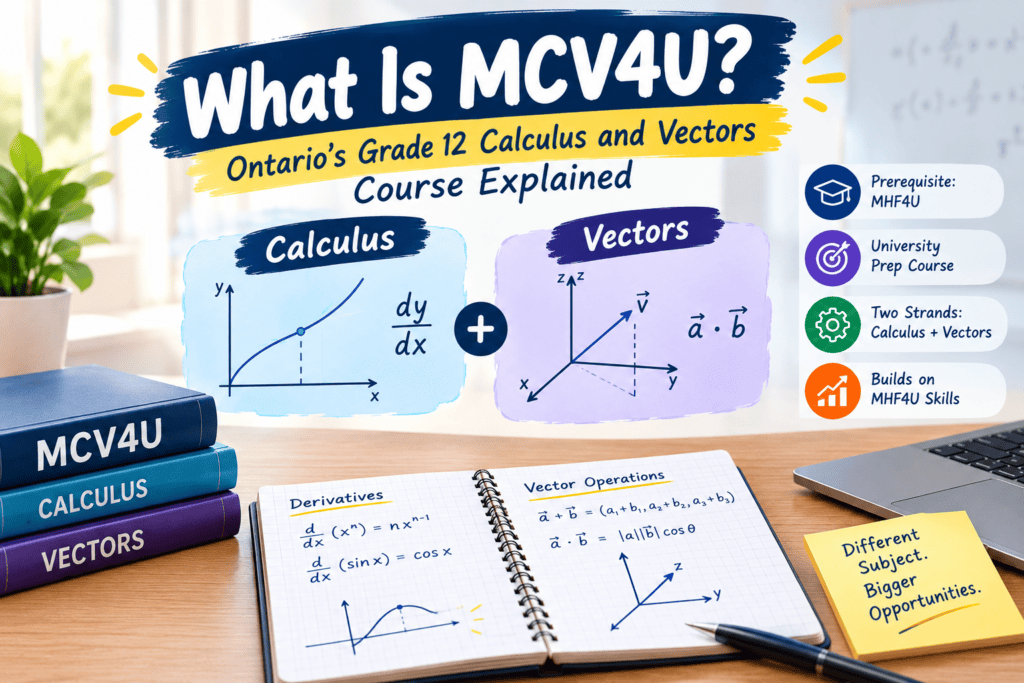
MCV4U is Ontario’s Grade 12 University Preparation course in Calculus and Vectors, worth one credit. Its prerequisite is Advanced Functions (MHF4U), which must be completed either before MCV4U or taken at the same time, since the calculus portion of the course leans heavily on function skills built in MHF4U.
The course is split cleanly into two halves that don’t overlap much in technique, which is part of what makes it feel like two courses squeezed into one semester rather than a single, gradually building subject.
Who Needs to Take MCV4U?
MCV4U is aimed at students heading into engineering, computer science, physical sciences, mathematics, and some business or economics programs. Most Ontario universities in these fields list it as a required or strongly recommended admission course, not an optional extra, and skipping it can quietly close off programs a student hasn’t even applied to yet.
What Does MCV4U Actually Cover?
The course runs two distinct strands side by side in a single semester, which is part of why it feels heavier than earlier math courses. Each strand has its own vocabulary, its own techniques, and its own way of thinking about a problem.
The Calculus Strand
This strand starts with average and instantaneous rates of change and an introduction to limits, then moves into derivatives, using rules for polynomial, trigonometric, exponential, and radical functions.
From there, students apply derivatives to curve sketching, using first and second derivative tests to identify maximums, minimums, and points of inflection, and to optimization problems, where calculus is used to find the best possible outcome in a real-world scenario like minimizing cost or maximizing area.
The Vectors Strand
The vectors strand shifts almost entirely away from calculus. Students work with geometric and algebraic vectors in two and three dimensions, covering operations like addition, scalar multiplication, and the dot and cross products. This strand extends into lines and planes in three-dimensional space, where vectors are used to describe and find intersections between them, connecting directly to physics applications like force and motion.
How Is MCV4U Different From MHF4U?
MHF4U studies what a function looks like, its shape, behaviour, and algebraic properties. MCV4U asks a different question entirely: how does that function change, and where does it point in space. One course is about understanding structure; the other is about understanding motion and direction.
Why a Shaky MHF4U Foundation Follows You Into MCV4U?
Calculus doesn’t wait for algebra to catch up. A weak grip on function transformations, trigonometric identities, or algebraic manipulation from MHF4U resurfaces immediately once derivatives and optimization begin, often within the first couple of weeks.
Students who found MHF4U difficult sometimes assume MCV4U is a fresh start, a chance to leave old struggles behind. In practice, it’s built directly on that same foundation, and the specific skills that felt shaky before, factoring, simplifying trig expressions, interpreting graphs, are exactly the ones calculus problems lean on. Our breakdown of what MHF4U actually covers is worth revisiting if that course still feels shaky before diving into this one.
Is MCV4U Actually Hard?
MCV4U isn’t harder because any single idea is more difficult than what came before. It’s demanding because two full strands of new material, calculus and vectors, run in parallel over one semester, and the pace rarely slows down to review earlier units once the course moves on.
Where Most Students Actually Lose Marks?
A few patterns show up again and again across both strands. In the calculus strand, students mix up which derivative rule a question actually needs, especially when the chain rule is hiding inside a product or quotient rule and the question doesn’t announce it. In optimization problems, the struggle is rarely the calculus itself, it’s translating a word problem into variables and equations before any differentiating even starts.
In the vectors strand, a common trip-up is confusing when to use a dot product versus a cross product, since both show up in similar-looking geometry and physics questions but answer completely different things. None of these come from a lack of ability. They come from patterns that are easy to fix once someone points them out clearly.
How Can You Set Yourself Up for a Strong Start?
The first few weeks of MCV4U matter more than they seem to. Limits and rates of change look simple on the surface, but they’re the foundation every later unit depends on, and gaps here tend to compound rather than disappear as the course moves into derivatives and optimization.
Reviewing MHF4U concepts as they resurface, writing out full steps instead of jumping straight to an answer, and getting feedback early rather than after a test comes back are the habits that separate a smooth semester from a scramble in November.
Because the course covers so much ground so quickly, small early gaps rarely stay small for long. If you want that kind of support built in from day one, our Grade 12 Calculus and Vectors tutoring is designed around exactly this transition.
Final Thoughts
MCV4U isn’t “more MHF4U.” It’s a new subject, calculus and vectors, built on the foundation MHF4U was supposed to leave behind. Understanding that difference early makes the whole semester easier to plan for, rather than something to catch up on after the first test.
The students who do well here aren’t necessarily the ones who found MHF4U easy. They’re the ones who treat MCV4U as its own course, with its own habits to build from week one, rather than assuming last semester’s routine will carry them through.
Frequently Asked Questions
What is MCV4U in Ontario?
MCV4U is the Grade 12 University Preparation Calculus and Vectors course, a 1.0 credit course covering derivatives, optimization, curve sketching, and two- and three-dimensional vectors.
Do I need MHF4U before taking MCV4U?
Yes. MHF4U is a required prerequisite for MCV4U, and it must be completed either before MCV4U or taken concurrently with it, since MCV4U’s calculus content depends directly on function skills from MHF4U.
Is MCV4U harder than MHF4U?
MCV4U isn’t necessarily more difficult concept by concept, but it covers two full strands, calculus and vectors, in one semester, which makes the workload and pace noticeably heavier than a single-topic course.
Can I take MCV4U without finishing MHF4U first?
Only if you take both courses concurrently, since MHF4U is a formal prerequisite. Taking MCV4U without any MHF4U background isn’t an option under the Ontario curriculum.
What university programs require MCV4U?
MCV4U is commonly required or recommended for engineering, computer science, physical sciences, mathematics, and select business or economics programs at most Ontario universities.