Unlike most algebra, proving a trig identity doesn’t follow one fixed set of steps, which is exactly why it can feel like starting from scratch every single time. At TutorBoost, students bring us this exact frustration constantly, so here’s a real method, plus the specific mistakes that quietly cost marks even when the final answer looks correct.
What Does “Proving” an Identity Actually Mean?
A proof isn’t the same as solving an equation, and treating it that way is exactly where most mistakes start.
Why You Can’t Just Cross-Multiply or Move Terms Across?
Solving an equation means finding the value of x that makes both sides equal. Proving an identity means showing two expressions are already equal for every possible angle, which changes the rules entirely. Cross-multiplying to clear a denominator uses the equality before you’ve actually established it, a mistake called circular reasoning, since you’re assuming the very thing you’re trying to prove.
Working Toward a Known Truth, Not Guessing an Answer
Instead, a proof only manipulates one side of the equation at a time, rewriting it step by step until it matches the other side exactly as written. Every step has to follow from an identity or algebraic rule you already know is true, which is what separates a genuine proof from simply making both sides look similar.
What’s the Actual Strategy for Starting a Proof?
There’s no fixed formula that solves every problem, but there is a consistent starting approach that works on almost every question you’ll see, the same kind of pattern-based thinking that shows up in other algebra-heavy topics like linear interpolation.
Start With the More Complicated Side
Pick whichever side has more terms, fractions, or functions, since that gives you more material to actually work with and simplify down. The simpler side becomes your target, the exact expression you’re trying to reach.
Convert Everything to Sine and Cosine First
Rewriting secant, cosecant, cotangent, and tangent entirely in terms of sine and cosine almost always makes the next step clearer, since it turns unfamiliar-looking expressions into ones built from only two functions you already know well:
sec θ = 1/cos θ csc θ = 1/sin θ cot θ = cos θ/sin θ tan θ = sin θ/cos θ
A Quick Way to Check Your Work Before Committing
Before writing out a full proof, graphing both sides of the identity separately can quickly confirm whether it’s actually true. If the two graphs produce identical curves, the identity holds, and it’s worth the time to write out the full algebraic proof. If the graphs don’t match, that’s a fast signal to double-check the original equation before spending time on a proof that was never going to work.
How Do You Know Which Identity to Use Next?
This is usually the actual sticking point for most students, not the algebra itself, and it’s the part our Ontario math tutoring sessions spend the most time on.
Look for What’s Missing on the Other Side
If a term appears on one side of the equation but not the other, that’s a genuine signal. Its presence or absence tells you exactly what needs to be introduced or eliminated to make progress, rather than guessing randomly at which identity to try.
Watch for Patterns That Match a Pythagorean Identity
Expressions like 1 minus sine squared, or one plus cotangent squared, are strong visual cues that a Pythagorean identity is about to simplify things significantly:
sin²θ + cos²θ = 1 1 + tan²θ = sec²θ 1 + cot²θ = csc²θ
Training yourself to spot these three patterns on sight saves real time once they start looking familiar.
What Mistakes Quietly Cost the Most Marks?
These aren’t careless errors in the usual sense, they’re specific habits that feel correct in the moment but undermine the entire proof.
Switching Which Side You’re Working On Midway
Jumping back and forth between sides partway through a proof secretly changes what you’re actually demonstrating, even when every individual step looks valid. Committing to one side and staying there until it matches the other is what keeps the logic intact.
Adding Complexity Instead of Removing It
Introducing an identity that makes an expression longer or messier, rather than simpler, is a sign you’ve picked the wrong tool for that step. A proof should generally be getting shorter and more familiar-looking as it goes, not the opposite.
What Does a Full Proof Actually Look Like Start to Finish?
Here’s the whole method applied to one real problem, including the kind of decision points that trip students up along the way.
A Complete Worked Example
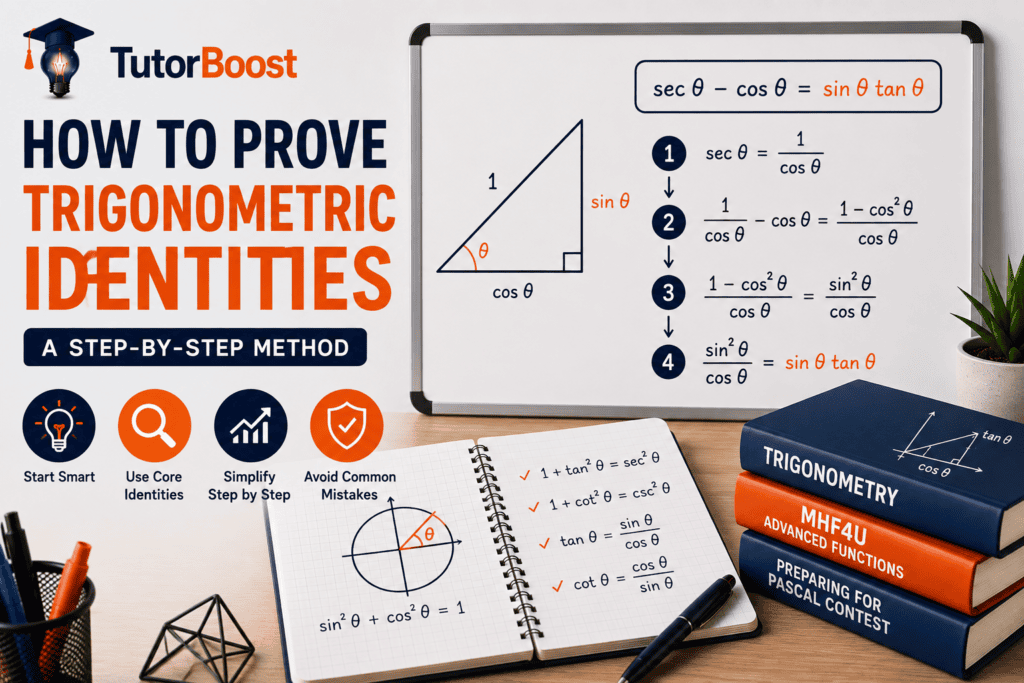
Prove that sec θ − cos θ = sin θ tan θ. The left side is more complicated, so that’s where the proof starts.
Step 1: Rewrite sec θ in terms of cosine: sec θ − cos θ = 1/cos θ − cos θ
Step 2: Combine both terms over a common denominator: 1/cos θ − cos θ = (1 − cos²θ) / cos θ
Step 3: Apply the Pythagorean identity 1 − cos²θ = sin²θ: (1 − cos²θ) / cos θ = sin²θ / cos θ
Step 4: Split sin²θ into sin θ · sin θ, then group one factor with 1/cos θ: sin²θ / cos θ = sin θ · (sin θ / cos θ) = sin θ · tan θ
The left side now matches the right side exactly. Notice the proof only ever worked on the left side, never crossed-multiplied, and got shorter and simpler at every single step, the three signs of a clean, valid proof.
A Second Example, Using a Different Starting Point
Prove that (1 − sin θ)(1 + sin θ) = cos²θ. This time the left side is already in a workable form, so it’s the natural place to start.
Step 1: Expand the product on the left side: (1 − sin θ)(1 + sin θ) = 1 − sin²θ
Step 2: Apply the Pythagorean identity sin²θ + cos²θ = 1, rearranged to isolate cos²θ: 1 − sin²θ = cos²θ
The left side now matches the right side exactly. This example shows the same core method working from a different starting point, expanding a factored expression rather than combining a fraction, which is exactly the kind of variation worth recognizing, since not every proof on a test will look like the first pattern you learn.
Final Thoughts
Proving trig identities comes down to picking the more complicated side, converting to sine and cosine, watching for Pythagorean patterns, and avoiding the handful of habits that quietly break the logic.
At TutorBoost, we help students build exactly this kind of pattern recognition, the part no formula sheet can teach on its own.
Frequently Asked Questions
Can you prove an identity by plugging in numbers?
No. Substituting a specific angle only shows the identity holds for that one value, not for every possible angle, which is what a genuine proof requires.
Is it ever okay to work on both sides at once?
Generally no, since manipulating both sides simultaneously risks circular reasoning. Working on one side until it matches the other keeps the logic valid throughout.
Why do some proofs take way longer than others?
Because there’s no single fixed method, some identities require spotting a less obvious pattern or trying more than one approach before finding the path that actually simplifies.
Do you need to memorize every identity to prove these?
The core reciprocal, quotient, and Pythagorean identities cover most situations. Recognizing when to apply them matters more than memorizing an exhaustive list.
Is this the same skill tested in MHF4U?
Yes, this type of proof-based reasoning is a core part of the What is MHF4U trigonometric functions unit, and it’s one of the areas students most often ask for extra support with.