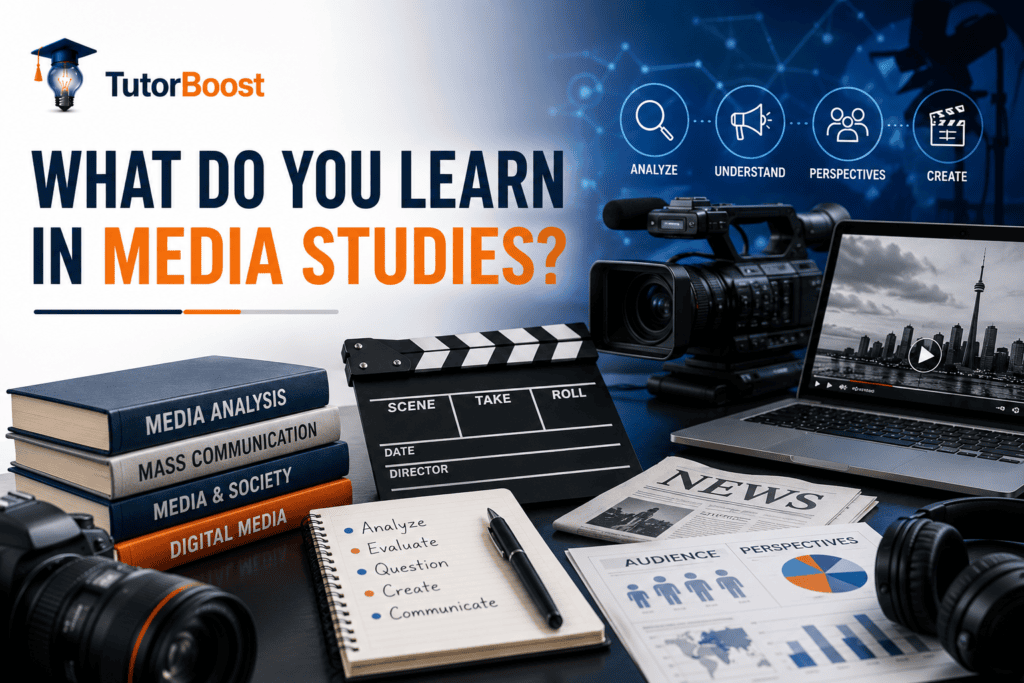
A lot of students sign up for Media Studies expecting to watch music videos and call it a class, then get genuinely surprised by how much actual analysis is involved.
At TutorBoost, we get asked constantly what this course really covers, so here’s the real breakdown, not the “easy elective” myth. Whether you end up learning it in a classroom or exploring online vs in-person tutoring for extra support, knowing what’s actually coming makes the whole course far less intimidating.
Is Media Studies the Same as a Digital Media or Production Class?
These two get confused constantly, but they teach genuinely different skills, even though both involve screens and content. This mix-up is one of the biggest reasons students walk into the wrong class expecting the wrong thing entirely.
What Media Studies Actually Focuses On?
Media Studies is fundamentally an analytical course. Students examine films, ads, news programs, and social media the same way an English class examines a novel, looking for meaning, bias, and intent behind what’s being communicated.
The focus is on understanding media, not primarily on building it, though hands-on creation does play a role later in the course.
Where Digital Media/Production Classes Differ?
A Digital Media or production-focused class, by contrast, teaches technical skills like video editing, graphic design software, or web development using tools like Photoshop or coding languages.
Someone searching “what do you learn in media studies” is often picturing this production-heavy version, when the actual course is closer to a critical thinking class that happens to use media as its subject matter, with essay writing and argument-building at its core.
How Do You Learn to “Read” Media Like a Text?
Media Studies treats films, advertisements, and shows the same way an English class treats a novel, as something with layers of meaning worth unpacking.
Understanding Media Language and Codes
Every media text uses specific “media codes,” like camera angles, color choices, music, or editing pace, to create meaning without a single word being spoken.
A low camera angle making a character look powerful, warm lighting suggesting comfort and safety, or a sudden cut signaling urgency are all examples of media language students learn to recognize and name deliberately, rather than just absorbing unconsciously the way most viewers do.
Identifying Overt and Implied Messages
Some messages in media are stated directly, while others are implied through tone, framing, or what’s deliberately left out entirely.
Learning to separate what a commercial actually says from what it’s subtly implying is one of the core skills the course builds, and it applies just as much to a news segment as it does to a soft drink ad promising happiness rather than just refreshment.
How Do You Learn to Spot Bias in Media?
Identifying bias is one of the core skills taught in Media Studies, and it’s far more concrete than it sounds once you see it demonstrated.
A Real Example of Spotting Bias
Imagine two news outlets covering the same protest. One headline reads “Protesters Clash With Police,” while another reads “Peaceful Demonstrators Met With Force.” Same event, completely different framing, and that word choice alone shapes how a reader feels about what happened before they’ve read a single additional sentence.
Spotting that kind of framing, in word choice, image selection, or even which details get left out entirely, is exactly the skill students practice repeatedly throughout the course.
Why the Same Media Text Affects Different Audiences Differently?
The same media text can land completely differently depending on who’s watching it, based on their background, beliefs, or prior experiences. A satirical ad might read as obviously exaggerated to one viewer and be taken completely at face value by another.
Understanding this helps explain why media literacy isn’t just about spotting “the truth,” but about recognizing how the same content gets interpreted in genuinely different ways by different audiences.
Students who struggle to put this kind of analysis into writing often benefit from extra support through our services, since explaining bias clearly on paper is its own separate skill from simply noticing it.
What Do You Learn About the Media Industry Itself?
Media Studies also covers how media actually gets made, funded, and distributed, not just how to analyze the finished product.
Production, Marketing & Distribution
Students learn how decisions about funding, target audience, and distribution platform shape a media product long before it ever reaches a viewer. A show designed for streaming, for example, gets built with very different pacing and marketing than one designed for traditional television.
Canadian Journalism History & Indigenous Media Coverage
In Ontario’s EMS3O course specifically, students also study the history of journalism in Canada and how coverage of Indigenous communities has changed over time.
This includes gaining familiarity with Indigenous media outlets and journalists, and understanding the connection between media representation and Indigenous rights. This is a genuinely Canadian curriculum element that sets the course apart from generic media literacy programs elsewhere.
Do You Get to Create Your Own Media Too?
Most Media Studies courses balance critical analysis with hands-on creation, giving students a chance to apply what they’ve learned rather than just studying it.
Common Types of Student-Created Projects
Typical projects include creating a short film, a mock advertisement, or a public service announcement, often followed by a reflection on the choices made and why. Making these deliberate decisions themselves, camera angle, framing, word choice, tends to deepen a student’s ability to spot the same choices when analyzing someone else’s media work later on.
A good instructor pushes students to justify these choices rather than just accepting a finished project at face value, which is exactly the kind of attentiveness worth checking for when evaluating whether a tutor is actually good at supporting project-based coursework like this.
Final Thoughts
Media Studies is far more analytical than its “easy elective” reputation suggests, covering everything from media language and bias to industry structure and hands-on production.
At TutorBoost, we help students build the critical thinking and writing skills this course genuinely demands. Ready to get started? Contact us or make an appointment today.
Frequently Asked Questions
Is Media Studies considered an easy course?
Not really. While it’s often assumed to be a lighter elective, the course involves genuine critical analysis, argument-based writing, and structured project work.
Do you need to be good at writing to do well in Media Studies?
Strong writing certainly helps, since much of the course involves explaining and defending your analysis in written form, similar to an English class essay.
Is Media Studies the same as Media Literacy?
They’re closely related but not identical. Media literacy refers to the broader skill of critically evaluating media in daily life, while Media Studies is the structured course that teaches and assesses that skill formally.
What kind of media do you actually study in class?
A wide range, including films, advertisements, news broadcasts, music videos, video games, and social media content, chosen specifically to demonstrate different techniques and messaging strategies.
Does Media Studies count as an English credit?
Yes, in Ontario specifically, Media Studies (course code EMS3O) falls under the English curriculum strand and counts as a full English credit, typically requiring ENG2D or ENG2P as a prerequisite.