A parent hears “literacy test” and pictures something vague and intimidating, an unknown hurdle standing between their teen and graduation. In reality, it’s a specific, well-defined requirement with a clear format, a clear scoring system, and a clear path forward either way.
At TutorBoost, we walk families through exactly what the OSSLT tests, how it’s scored, and what actually helps students prepare for it, without the guesswork.
What Is the OSSLT?
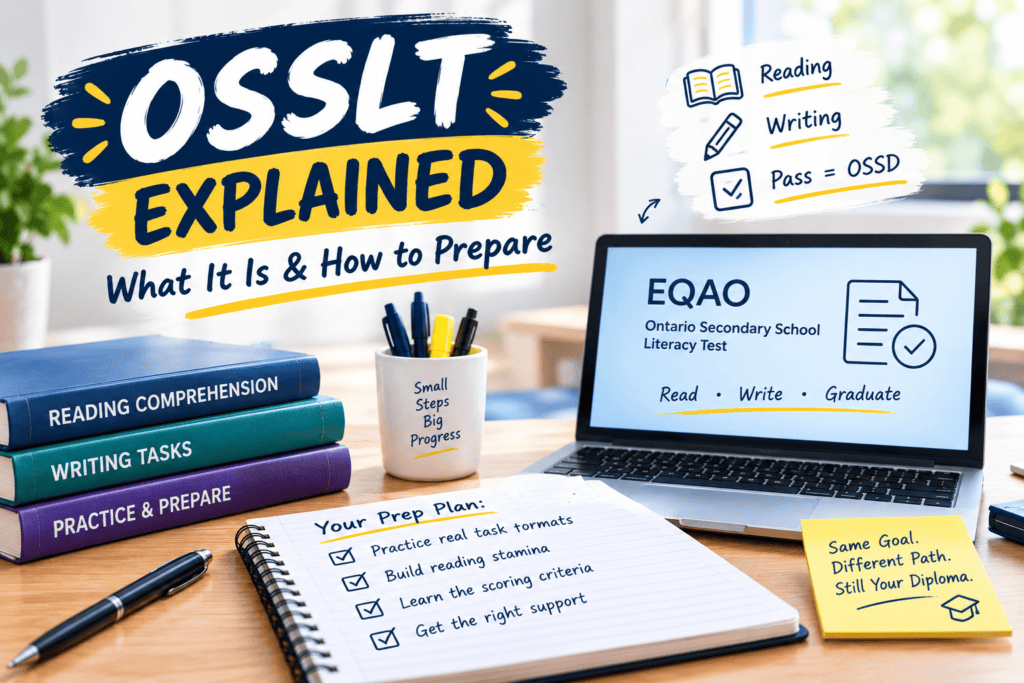
The OSSLT, or Ontario Secondary School Literacy Test, is a standardized test run by the Education Quality and Accountability Office (EQAO) that measures whether students meet the province’s minimum literacy standard: the reading and writing skills expected across all subjects by the end of Grade 9. Most students write it in Grade 10, on a computer, at their own school, under supervision.
Why It Exists?
The OSSLT isn’t testing new content or advanced English. It’s a functional literacy check, confirming that students can read a range of everyday texts and write clearly enough for academic and workplace demands. Passing it is one of the requirements for earning the Ontario Secondary School Diploma (OSSD), alongside credits and community involvement hours, not a separate academic course on its own.
What Does the OSSLT Actually Test?
The test runs across two sessions, combining reading comprehension with several writing tasks, and totals roughly two and a half hours of writing time split over two days.
The Reading Section
Students read a mix of informational texts, graphic materials like graphs and diagrams, and literary passages, then answer questions built around main idea, inference, and context. Many questions test whether a student can identify what a text is really implying, not just what it states outright, which is a different skill from simply reading quickly.
The Writing Section
The writing tasks include a news report answering the five W’s, an opinion piece or series of paragraphs built around a clear position, and shorter paragraph responses that ask for a specific, concise answer. Each task is scored on organization and clarity as much as correct grammar and spelling, so a technically correct answer can still lose marks if it’s poorly structured.
How Is the OSSLT Scored, and What Happens If You Don’t Pass?
Scores fall on a scale from 200 to 400, and a student needs 300 to pass, roughly a level 3 provincial standard. Results are reported as pass or fail only, with no percentage shown, and the outcome has no effect on a student’s actual course grades or GPA.
What Happens If a Student Doesn’t Pass?
A student who doesn’t pass can rewrite the test at a later administration, and there’s no limit on how many times they can attempt it. After two opportunities, with at least one unsuccessful result, a student becomes eligible for the Ontario Secondary School Literacy Course (OSSLC), a credit course that satisfies the same graduation requirement in place of the test.
Either route leads to the exact same diploma. Not passing on the first try changes the path, not the destination, which is worth remembering when a first result comes back lower than hoped.
Why Do Students Struggle With the OSSLT If It’s Not Advanced English?
Most students who find the OSSLT harder than expected aren’t actually struggling with the reading level itself. They’re struggling with formats they’ve simply never practiced under real time pressure before test day.
The Real Source of Lost Marks
Few students have written a formal news report or a structured series of paragraphs in an exam setting before this test, and graders look for a specific shape in each one. A student can write something reasonably thoughtful and still score lower than expected simply because the structure doesn’t match what’s being assessed, not because the ideas were wrong.
The same skill gap shows up in other courses that lean on structured analytical writing; our post on what students actually learn in Media Studies covers a similar case where the writing demands catch students off guard more than the actual content does.
How Should You Actually Prepare for the OSSLT?
Real preparation means practicing the exact task formats under timed conditions, not simply reading more in general or hoping familiarity will be enough on test day.
Practicing the Exact Task Formats
Writing a full practice news report and a full practice opinion piece, timed, matters far more than reviewing tips about how to write them. Comparing a sample Level 2 response against a Level 4 response is one of the fastest ways to see exactly what graders reward, often more useful than any written explanation of the scoring rubric.
Our English tutoring works through these exact task types directly with students, since watching the structure done correctly, then practicing it themselves, closes the gap far faster than general review ever does.
Getting the Right Kind of Support
Not every kind of help moves the needle here. A student preparing for the OSSLT benefits most from a tutor who checks the structure of a practice response line by line, the way a grader actually would, rather than just reading it over for grammar.
Our guide on how to find a quality online tutor in Canada breaks down exactly what to look for if you’re weighing support options before test day.
Building Reading Stamina and Vocabulary in Context
Reading a variety of real texts, news articles, opinion columns, short essays, builds the kind of comprehension the test actually rewards, especially the ability to infer an unfamiliar word’s meaning from context rather than recognizing it outright. Sustained reading and writing practice also builds the stamina needed to stay focused across a two-and-a-half-hour test, since rushed, late-session answers cost more marks than most students expect going in.
Final Thoughts
The OSSLT tests skills students have been building since elementary school, not a new subject to cram for in a few weeks. What actually determines the outcome is familiarity with the specific formats, practiced under real time pressure, not raw literacy ability.
Even for a student who doesn’t pass on the first attempt, the path to a diploma stays fully intact. With the right kind of preparation, most students walk in far more ready than they expect, and the test stops feeling like the vague, high-stakes unknown it’s often made out to be.
Frequently Asked Questions
What grade do you write the OSSLT in?
Most Ontario students write the OSSLT in Grade 10, though students who transfer in from another province or country, or who missed an earlier opportunity, may write it later.
What happens if you fail the OSSLT?
A student can rewrite the test at a later administration, with no limit on attempts. After two opportunities with at least one unsuccessful result, they become eligible for the Ontario Secondary School Literacy Course, which satisfies the same graduation requirement.
How many times can you take the OSSLT?
There’s no set limit on attempts. Students can continue rewriting the test in later administrations until they pass, or qualify for the OSSLC as an alternate route to the same diploma.
Is the OSSLT hard?
The reading level and content aren’t advanced, since the test is based on skills expected by the end of Grade 9. What makes it feel harder than expected is the unfamiliar task format, not the difficulty of the material itself.
Do international or transfer students need to write the OSSLT?
Yes. International students working toward an Ontario Secondary School Diploma, and students transferring into Grade 10 from another province or country, are generally required to write the OSSLT to meet the same literacy requirement.