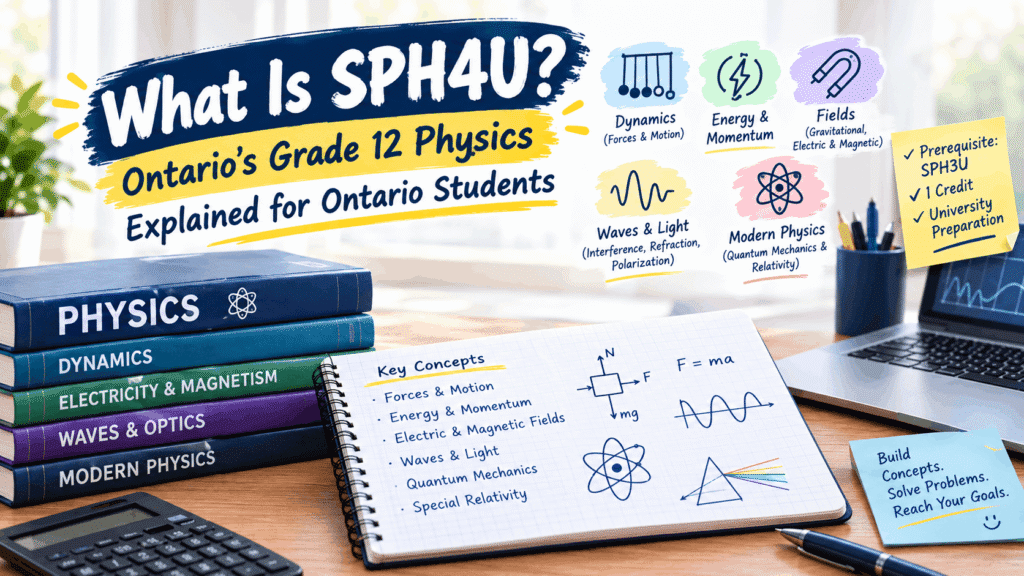
SPH4U is Ontario’s Grade 12 University Preparation Physics course. It builds on Grade 11 Physics and takes students deeper into dynamics, energy and momentum, gravitational, electric and magnetic fields, waves and light, quantum mechanics, and special relativity. The course is also an important prerequisite for many Ontario engineering and physical-science pathways.
For students considering Physics in Grade 12, understanding the course before enrolling can make the transition much easier. At TutorBoost, the goal is not simply to memorize formulas but to understand the Physics behind them and learn how to apply that understanding to unfamiliar problems.
What Does SPH4U Mean?
SPH4U is the course code for Grade 12 Physics at the university-preparation level in Ontario. The “4” identifies it as a Grade 12 course, while “U” means University Preparation.
SPH4U is worth one Ontario high school credit and is commonly structured around about 110 hours of instruction.
What Is the Prerequisite for SPH4U?
The official SPH4U prerequisite is SPH3U, Grade 11 Physics, University Preparation. Grade 12 Physics assumes students already understand the foundations introduced in that course.
What Should You Remember From SPH3U?
Before starting SPH4U, it helps to be comfortable with vectors, kinematics, forces, Newton’s laws, energy, waves, electricity, and basic mathematical problem-solving.
Weak Grade 11 foundations do not disappear in Grade 12. Instead, SPH4U adds more complex situations and expects students to combine several ideas within one problem.
What Do You Learn in SPH4U?
The SPH4U course outline moves from familiar mechanics into increasingly abstract areas of Physics. Ontario course materials organize the course around five major units: dynamics, energy and momentum, fields, the wave nature of light, and modern physics.
What Is Covered in Dynamics?
Dynamics explores forces and motion in greater depth, including motion in a plane, vectors, and uniform circular motion.
Students need to connect diagrams, physical principles, and equations rather than simply choosing a formula based on the numbers given.
What Do You Learn About Energy and Momentum?
This unit develops work, energy, impulse, momentum, and conservation laws. Problems can involve one or two dimensions, so students often need to decide which conservation principle applies before beginning the calculation.
What Are Gravitational, Electric and Magnetic Fields?
SPH4U examines how gravitational, electric, and magnetic fields interact with matter.
These ideas require both qualitative reasoning and quantitative problem-solving, making this unit more abstract than simply observing motion.
What Do You Learn About Waves and Light?
Students investigate wave behaviour including interference, diffraction, refraction, polarization, and electromagnetic radiation.
The focus is not only on calculating values but also on explaining what wave behaviour tells us about light.
What Is Modern Physics in SPH4U?
Modern Physics introduces students to quantum mechanics, wave-particle duality, and Einstein’s special relativity. These topics can feel unfamiliar because everyday intuition does not always match the physical models being studied.
Is SPH4U Hard?
SPH4U can be challenging because it combines conceptual understanding with multi-step mathematical problem-solving. How difficult it feels often depends on the strength of your Grade 11 Physics, algebra, vectors, and problem-solving habits.
Students usually struggle when they try to memorize equations without understanding the physical situation. Grade 12 Physics asks more often: What principle applies here, and why? That shift from formula recall to reasoning is what makes SPH4U feel different from earlier courses.
How Much Math Is Used in SPH4U?
Math appears throughout SPH4U because equations are used to describe motion, forces, energy, momentum, fields, and waves.
Students regularly work with algebra, scientific notation, graphs, vectors, trigonometry, proportional relationships, and equation rearrangement.
Strong Math skills therefore make Physics problem-solving much easier. Topics such as proving trigonometric identities may not be SPH4U Physics topics themselves, but becoming comfortable manipulating mathematical relationships can strengthen the same reasoning skills used when rearranging and interpreting Physics equations.
Do You Need Calculus for SPH4U?
Calculus is not listed as the prerequisite for SPH4U; SPH3U is. Students still need strong algebra and mathematical reasoning, while Calculus and Vectors may be taken separately depending on university plans.
Is SPH4U Harder Than SPH3U?
SPH4U generally goes deeper than SPH3U rather than simply introducing more formulas. Problems can involve more steps, stronger vector reasoning, unfamiliar field concepts, and abstract topics such as relativity and quantum theory.
Students who understood the reasoning behind Grade 11 Physics usually have a better starting point than students who relied mainly on memorizing example solutions.
Do You Need SPH4U for University in Ontario?
Whether you need SPH4U depends on the program. Many engineering programs require Grade 12 Physics. For example, current Ontario admission requirements for both University of Toronto Engineering and York University Engineering include SPH4U alongside senior Math, Chemistry, and English prerequisites.
Other university programs may recommend Physics, accept it as one of several Science choices, or not require it at all. Always check the prerequisites for the specific universities and programs you are considering rather than assuming every STEM program has identical requirements.
How Can You Prepare for SPH4U?
Preparing for SPH4U should begin with the concepts that Grade 12 Physics assumes you already know.
Review vectors, forces, kinematics, energy, algebra, and trigonometry before the course becomes busy. When solving Physics problems, practise drawing the situation first and choosing the physical principle before reaching for an equation.
The same approach applies to diagrams. A student who understands what a diagram represents is less likely to rely on memorized placement rules. Even foundational skills such as correctly interpreting circuit schematic diagrams can reinforce the habit of connecting a Physics representation to what is physically happening.
How Should You Study for SPH4U?
A useful SPH4U study process is Understand → Represent → Solve → Check.
First, understand what is happening physically. Next, represent the situation with a free-body diagram, vector diagram, field diagram, or graph where appropriate. Then choose the relevant principle and solve the problem carefully.
Finally, check the units, direction, sign, and magnitude of the answer. A mathematically correct calculation can still be physically unreasonable.
What Common SPH4U Mistakes Should You Avoid?
One of the biggest mistakes is memorizing formulas without learning when they apply. Students also lose marks by skipping diagrams, confusing vector directions, substituting values too early, making algebra errors, ignoring units, or reading worked solutions instead of attempting problems independently.
When the same error keeps appearing, identify whether the gap is in Physics understanding, Math, or the problem-solving process.
When Can SPH4U Tutoring Help?
Extra support can be useful when you understand lessons in class but cannot independently decide how to start a problem.
Personalized Physics tutoring can help students work through vectors, dynamics, energy, fields, waves, and other SPH4U concepts while identifying whether the real obstacle is the Physics concept or the Math behind it.
The aim should be to make students less dependent on worked solutions, not more dependent on them.
What Should You Know Before Choosing SPH4U?
Think of SPH4U through five ideas: Foundation → Math → Physics → Practice → Pathway.
SPH3U provides the foundation. Math supports the calculations. Physics explains what those calculations mean. Practice develops problem-solving ability, and your intended university pathway determines how important SPH4U is for admission. Understanding those pieces before Grade 12 makes the course far less mysterious.
FAQs
What does SPH4U stand for?
SPH4U is Ontario’s Grade 12 Physics course at the University Preparation level.
What is the prerequisite for SPH4U?
Students normally need SPH3U, Grade 11 University Preparation Physics, before taking SPH4U.
Is SPH4U hard?
It can be challenging because it combines mathematical problem-solving with increasingly abstract Physics concepts.
Do you need Calculus for SPH4U?
Calculus is not the official prerequisite for SPH4U. Strong algebra, vectors, and mathematical reasoning are more immediately important.
What university programs require SPH4U?
Many Ontario engineering programs require SPH4U, while requirements for Science and other STEM programs vary by university and program.