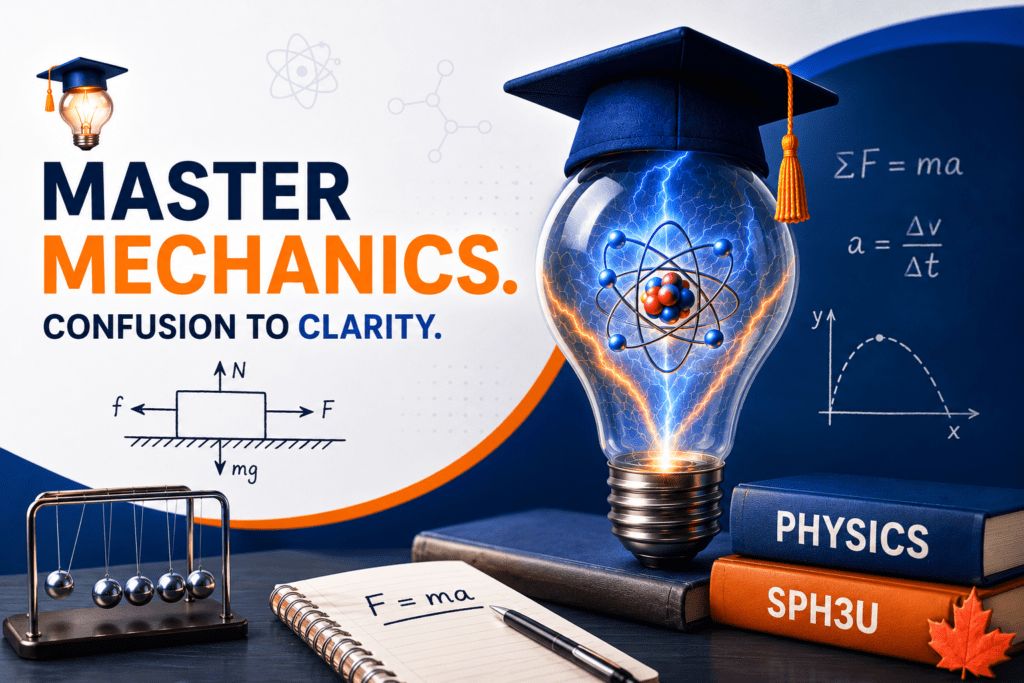
You’re staring at a free body diagram and your mind goes blank. Your teacher talks about “net force” like everyone already understands it. Your friends seem to get it. You don’t. Last night, you thought: “Maybe I’m just not a physics person. Maybe mechanics are impossible.”
But here’s the truth: mechanics confusion doesn’t mean you lack talent. It means your misconceptions need expert correction. TutorBoost in North York removes that isolation and rebuilds your foundation while you catch up.
What Actually Happens When You Don’t Understand Mechanics?
Mechanics confusion isn’t about failing the test. It’s about understanding forces and motion intellectually but freezing when you have to apply them.
You memorize formulas. You know F=ma. But when a problem asks you to solve it, you freeze. Where do you start? Which formula? What forces actually matter here?
This is the symptom that crushes North York students. Free body diagrams feel like impossible visual puzzles. Net force stays abstract instead of concrete. You can’t translate a word problem into a physics problem because identifying forces feels impossible.
The invisible forces make it worse. Gravity, friction, normal force, you can’t see them, so they feel unreal. Yet your teacher expects you to account for them instantly. When you don’t, you feel lost.
The worst part? Mechanics failure cascades. Everything after mechanics builds on it. Circular motion, energy, waves, all impossible without mechanics mastery. Fail mechanics in September, and your entire year crumbles.
Why Do North York Physics Students Struggle With Mechanics?
The struggle isn’t random. There are concrete reasons mechanics confuses even smart students.
Invisible forces create false intuition. You’ve never seen gravity act directly. Friction seems obvious in real life (things stop), but physics says objects keep moving without friction. Your brain says one thing. Physics says another. This cognitive dissonance sits in your mind unresolved.
Your brain thinks differently than Newton. Before learning physics, you assume force maintains motion. You push a ball, it rolls. You stop pushing, it stops. Pre-Newtonian thinking feels natural. Newton’s laws feel wrong.
Multiple simultaneous forces overwhelm. One object has gravity, normal force, applied force, friction, sometimes five or six forces acting at once. Which matter? Which can you ignore? Your teacher assumes you know this instinctively. You don’t.
Free body diagrams demand meta-cognitive skill. Drawing isn’t the hard part. The hard part is first identifying every force, representing them as vectors, then understanding what they mean collectively. This three-layer skill feels impossible at first.
Math and physics collide. You understand force conceptually. But vector components require trigonometry. Suddenly you’re struggling with sin and cos while trying to understand physics. The subject splits into “math I can do” and “physics I don’t understand.” Confusion multiplies.
Ontario’s SPH3U moves fast. Teachers assume kinematics foundation is solid before teaching dynamics. If motion understanding is shaky, forces become incomprehensible.
What Happens If You Stay Confused About Mechanics?
Confusion now means struggle forever in this course.
Mechanics is the foundation. Everything else stacks on top. Skip mechanics, and circular motion becomes impossible. Energy problems don’t make sense. Momentum concepts won’t click. Each topic gets harder because each depends on mechanics mastery.
Your grade reflects this immediately. Mechanics quiz fails become circular motion quiz fails become final exam disaster. One weak foundation collapses the entire structure.
The transcript damage is real. Engineering programs weight it heavily. Science programs require it. One failed mechanics unit becomes permanent record.
But worse is the psychological cost. You start telling yourself, “I’m not a physics person.” That belief spreads to calculus, chemistry, and future science courses. If you’re struggling with these subjects, online science tutoring
can help you strengthen your understanding and rebuild confidence. Career paths close.
Not because you lack ability, but because struggling with science for one semester hardened into identity. Career paths close. Not because you lack ability, but because struggling with science for one semester hardened into identity.
This semester matters. You can fix mechanics confusion in four weeks with tutoring. Or you can spend four months confused, panic in exam prep, and retake the course. What’s more valuable hours of expert help now or months of frustration?
How Does Physics Tutoring in North York Stop Mechanics Confusion?
Expert tutoring doesn’t just “help with physics.” It diagnoses exactly where your confusion lives.
A tutor listens to your thinking and identifies the specific gap. You think “force maintains motion”? That’s a pre-Newtonian misconception. A tutor breaks that immediately using a real example. Ice skating. No friction. Object keeps moving. Newton’s First Law becomes tangible, not theoretical.
Personalized, one-on-one tutoring means explaining mechanics in your way, not your teacher’s way. Your learning style matters. Visual? Tutors use diagrams and animations. Kinesthetic? They build physical models. Step-by-step logic? They break concepts into tiny pieces.
The concrete-first approach rebuilds understanding from the ground up. Real examples come before formulas. Car braking → inertia concept → F=ma formula. Not the textbook backwards approach of “learn formula, then understand it.”
Free body diagrams transform through guided practice. A tutor shows you what you’re missing, that hidden force, that wrong vector direction. After weeks of one-on-one guidance, identifying forces becomes automatic, not impossible.
Vector components stop being “math torture.” A tutor separates physics understanding from trigonometry. Learn them individually, then combine them. Suddenly sin and cos make sense because you understand what they represent physically.
Problem-solving strategy emerges through repetition. Word problem → Identify known values → Identify forces → Select formula → Solve → Check if answer makes physical sense. This framework, practiced with expert guidance, becomes your automatic approach.
Ontario curriculum expertise matters too. A TutorBoost tutor knows SPH3U specifically. They know North York high schools’ pacing. They know what your teacher expects. This alignment accelerates clarity.
Why Can’t YouTube or Your Textbook Fix This?
YouTube seems like the answer. Hundreds of physics videos. But that’s the problem.
Khan Academy explains forces one way. Crash Course Physics explains differently. 3Blue1Brown uses yet another approach. Watch all three and you’re more confused, not less. Different notations. Different examples. Contradictory explanations. You don’t know which to trust.
Textbooks assume foundation you don’t have. They state Newton’s laws as self-evident. But your intuition screams they’re wrong. Textbooks don’t address your pre-Newtonian thinking. They move forward, leaving you confused and isolated.
Self-study means misconceptions harden invisibly. You solve a practice problem wrong. You check the answer. “Oh, I used the wrong formula.” You think you understand (formula memorization), but the misconception remains. When your teacher’s test shows you used the wrong formula again, you realize understanding never happened.
What’s different with tutoring: Real-time correction. You explain your thinking out loud. A tutor hears: “You think force is needed to keep something moving.” Immediate response: “That’s actually a misconception. Let me show you why that’s impossible.”
Misconceptions get addressed before they harden into false certainty. Expert guidance catches what YouTube can’t, your specific mental block.
Which Mechanics Topics Cause the Most Confusion?
Newton’s First Law confuses almost every student. Objects need force to keep moving—this feels obvious in real life. Yet the law says the opposite. Inertia is the real concept. A tutor shows ice skating, explains why an object keeps moving without force, then teaches inertia properly.
Newton’s Second Law (F=ma) seems simple mathematically. But applying it is a different challenge. Students memorize the formula then get stuck on: “What forces act here?” A tutor teaches: identify forces first, then apply F=ma. The formula becomes a tool, not the point.
Free body diagrams feel impossible because they demand three simultaneous skills: identifying forces, drawing them as vectors, and understanding what they mean together. Breaking this into steps removes the impossible feeling.
Net force misconceptions are common. Students think it’s an extra force added to real forces. One clarifying conversation fixes this completely.
Vector components add math complexity on top of physics concepts. Tutors separate them, teach each independently, then integrate understanding.
Should You Get Online or In-Person Tutoring?
The format matters less than the expert.
Online offers flexibility and comfort at home. You can record sessions. Scheduling adjusts to your life. Digital whiteboards work perfectly for drawing free body diagrams.
In-person offers immediate presence and hand-drawn clarity. Some students focus better with a physical person across the table.
The truth: One-on-one expert tutoring works in both formats. Choose whichever removes your barriers. Travel burden? Try online. Scheduling constraints? Look for flexible tutors. North York offers both options.
For mechanics specifically, both formats work equally well. Diagrams, explanations, problem-solving, all happen effectively online or in-person.
Final Thoughts
This is the real choice in front of you right now. Accept confusion and watch it spread through your entire year. Fight it now and rebuild your foundation in weeks. The difference isn’t huge effort, it’s expert, personalized guidance during crisis point.
Four weeks of tutoring transforms months of confusion into clarity. TutorBoost tutoring in North York specializes in exactly this taking mechanics confusion and turning it into mastery.
You can stay isolated with YouTube and textbooks. Or you can work one-on-one with an expert who diagnoses your specific gap and fixes it systematically. The breakthrough is available. The question is whether you’re ready to take it.
FAQs
How fast do mechanics concepts actually click?
Most students understand core concepts within two to three weeks. Full mastery takes six to eight weeks.
What if I’m too far behind?
Tutors rebuild foundations while catching up simultaneously. That’s exactly what personalized tutoring does.
Do I need strong math skills for mechanics?
Basic algebra is required. Tutors teach physics and math separately if needed.
Will tutoring help me pass SPH3U exams?
Yes. Mechanics mastery means every exam question becomes solvable once you understand the concepts.
Can online tutoring explain free body diagrams clearly?
Absolutely. Digital whiteboards allow tutors to draw and explain diagrams in real-time.