
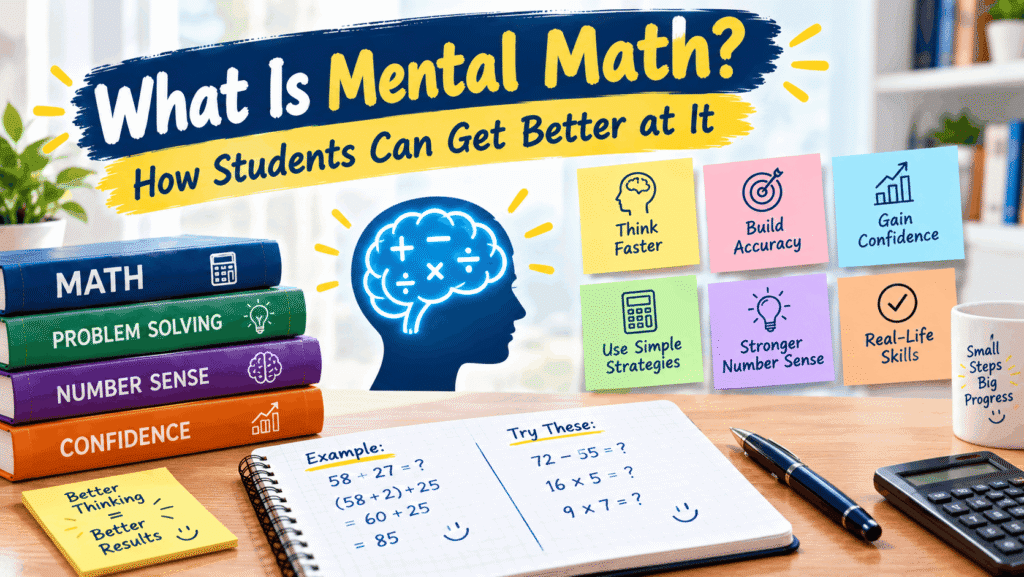
Mental math is solving math problems in your head, without a calculator, paper or pencil. It is the skill behind working out a sale price, checking your change, or sensing that an answer just looks wrong.
At TutorBoost, our tutors see the same pattern again and again: a student knows the steps but freezes the moment the pencil is taken away. This guide explains what mental math is, why it matters in Ontario classrooms, and how to build it so it sticks.
What Is Mental Math?
Mental math (also written “mental maths”) is calculating in your head by using number sense, not just memory. If you have ever wondered what a mental math problem looks like, 58 + 27 is one. A student who solves it mentally is not picturing a written column. They are rearranging the numbers into easier ones.
What is a mental math strategy?
A mental math strategy is a shortcut that turns a hard calculation into an easy one, such as rounding to a friendly number and then adjusting. Students choose the strategy that fits the numbers in front of them.
Is mental math the same as memorizing facts?
No, but the two work together. A University of Toronto (OISE) article notes that high-achieving eight-year-olds more often use derived facts, while low achievers tend to rely on counting, which is slower and easier to get wrong.
Why Is Mental Math Important for Ontario Students?
Mental math builds number sense, the feel for how numbers relate to each other, and that feel makes almost every later topic easier. The Ontario Grades 1–8 math curriculum places “developing mental math strategies” right beside learning multiplication facts.
| Grade | What students are expected to know |
| Grade 3 | Multiplication facts of × 2, × 5 and × 10, and related division facts |
| Grade 4 | Multiplication facts from 1 × 1 to 10 × 10 |
| Grades 5 and 7 | Multiplication facts from 0 × 0 to 12 × 12 |
Mental math also gives students a built-in way to check their work. A student who can tell an answer is far too big catches the slip before it costs marks. Daily life uses it too: discounts, tips and change all happen without a pencil.
What Are the Best Mental Math Strategies?
The best mental math strategies break awkward numbers into friendly ones, such as tens, fives and doubles. These eight handle most everyday calculations.
How does making ten work?
Move just enough from one number to round the other up. For 58 + 27, take 2 from 27 to make 58 into 60, then add the remaining 25. The answer is 85.
What is the compensation strategy?
Round to an easy number, then fix the difference. For 402 − 198, subtract 200 to get 202, then add 2 back. The answer is 204.
How do you subtract by adding?
Ask what you would add to the smaller number to reach the larger one. For 72 − 55, think 55 + 17 = 72. The answer is 17.
How do you add left to right?
Start with the biggest place value, because that is how most people think about numbers. For 34 + 17, add the tens first (30 + 10 = 40), then the ones (4 + 7 = 11). Together that makes 51.
How do you break numbers apart?
Split one number into tens and ones. For 6 × 14, work out 6 × 10 = 60 and 6 × 4 = 24, then add them to get 84.
How do you multiply by 9?
Treat 9 as 10 minus 1. For 9 × 7, work out 10 × 7 = 70, then subtract one 7 to get 63. It works for bigger numbers too.
How do doubling and halving help?
Multiplying by 5 is half of multiplying by 10. For 16 × 5, think 16 × 10 = 160, then halve it to get 80.
How Can Students Get Better at Mental Math?
Students get better at mental math by estimating first, learning a few facts well, and practising in short bursts.
Why should students estimate first?
Estimating gives a target to check against. For 198 × 23, round to 200 × 23 = 4,600, so the exact answer should land just under that. The same habit catches slips in senior topics like the sine and cosine law.
Why should students learn their facts first?
Quick recall of number bonds, doubles and tens frees up working memory. That leaves room for the harder part of the problem instead of spending effort on the basics.
Are short daily sessions better than long ones?
Usually, yes. A few problems each day tend to work better than one long drill. The OISE article also notes that timed testing can raise math anxiety, so accuracy should come before speed.
How can everyday moments help?
Ask your child to work out the sale price, the tip or the change, then ask, “What strategy did you use, and why?” Explaining the thinking shows whether they understand it or are guessing.
How Do You Know If a Student Needs Extra Help With Mental Math?
A student may need extra help when mental math stays slow or stressful long after their grade expects fluency.
Counting on fingers is normal in the early years. It becomes a concern when it is still the main method for facts a student should know by Grade 3 or 4. Other signs include freezing on timed questions or avoiding any problem with numbers in it. These are usually gaps in number sense, not a lack of ability. The OISE article suggests the fix is teaching a new strategy, not more practice with the same one.
That is where math tutoring helps. A TutorBoost tutor rebuilds the foundation one strategy at a time, so students stop guessing and start choosing a method. You can see every subject we cover on our tutoring services page.
FAQs
What is mental math in simple words?
Solving math problems in your head, without a calculator or written working, using number sense and simple strategies.
Is mental math the same as estimation?
Not quite. Estimation finds an approximate answer, while mental math often finds an exact one. Estimation is one tool used inside it.
Is mental math still useful when calculators are everywhere?
Yes. It builds number sense and lets students judge whether a calculator answer makes sense.
Does mental math replace written work?
No. It supports it. Students still show their steps on tests, but mental math helps them check those steps.
Are timed drills a good way to practise mental math?
Not on their own. Timed drills can raise math anxiety, so short, untimed practice with accuracy first works better.