A balanced chemical equation has the same number of each type of atom on both sides of the arrow. Getting there takes four steps and some careful counting.
At TutorBoost, our science tutors see students lose marks here for one reason: they change the formulas instead of the numbers in front of them. This guide shows the method, worked examples from water to acid–base reactions, and the mistakes to avoid.
What Does It Mean to Balance a Chemical Equation?
Balancing a chemical equation means adjusting the numbers in front of each substance until both sides contain the same atoms. Atoms are never created or destroyed in a reaction, so the equation has to show that.
What are reactants, products and coefficients?
Reactants are the starting substances on the left, and products are what forms on the right. The arrow means “reacts to form.” A coefficient is the big number in front of a formula, such as the 2 in 2H₂O.
Why must chemical equations be balanced?
The law of conservation of mass says matter is neither created nor destroyed in a chemical reaction. An unbalanced equation breaks that rule and gives wrong amounts in later calculations.
What is the difference between coefficients and subscripts?
A subscript is the small number inside a formula, and it defines the substance. H₂O is water, but H₂O₂ is hydrogen peroxide. So you change coefficients only, never subscripts, as this university-hosted chemistry guide also stresses.
How Do You Balance a Chemical Equation Step by Step?
You balance an equation in four steps: write the skeleton equation, count the atoms, add coefficients, then recount.
What are the four steps?
- Write the unbalanced (skeleton) equation with the correct formulas.
- Count each type of atom on both sides.
- Add coefficients one element at a time.
- Recount every element and keep the numbers as small as possible.
For Fe + O₂ → Fe₂O₃, the counts look like this:
| Element | Unbalanced (left / right) | Balanced (left / right) |
| Fe | 1 / 2 | 4 / 4 |
| O | 2 / 3 | 6 / 6 |
Which element should you balance first?
Start with an element that appears in only one substance on each side. Leave hydrogen, oxygen and any lone element such as O₂ for last, because changing them rarely disturbs the rest.
How do you check that an equation is balanced?
Count each element again on both sides. To get a total, multiply each coefficient by the subscript, so shaky times tables slow students down here.
What Are Some Worked Examples of Balancing Equations?
The same four steps work on every equation, so begin with simple ones and build up.
How do you balance H₂ + O₂ → H₂O?
The left has 2 H and 2 O, but the right has 2 H and 1 O. Put a 2 in front of H₂O to fix oxygen, which makes hydrogen 4 on the right. Then put a 2 in front of H₂. The answer is 2H₂ + O₂ → 2H₂O.
How do you balance a combustion equation?
Combustion means burning in oxygen, so the products are carbon dioxide and water. In CH₄ + O₂ → CO₂ + H₂O, carbon is already balanced. Two waters give 4 hydrogen atoms, and the 4 oxygen atoms on the right need 2O₂. That gives CH₄ + 2O₂ → CO₂ + 2H₂O. Propane works the same way: C₃H₈ + 5O₂ → 3CO₂ + 4H₂O.
How do you balance Fe + O₂ → Fe₂O₃?
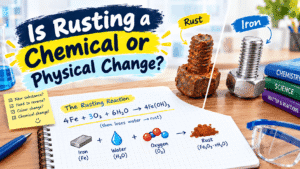
Oxygen is 2 on the left and 3 on the right, so use the lowest common multiple, 6. That needs 3O₂ and 2Fe₂O₃, which gives 4 iron atoms on the right. Add a 4 in front of Fe. The answer is 4Fe + 3O₂ → 2Fe₂O₃.
How Do You Balance Harder Equations?
Harder equations usually involve polyatomic ions, acid–base reactions or odd numbers of oxygen atoms. They use the same steps with a few extra tricks.
How do polyatomic ions make balancing easier?
If a group such as NO₃ appears unchanged on both sides, count it as one unit. In Pb(NO₃)₂ + NaCl → NaNO₃ + PbCl₂, there are 2 nitrate units on the left and 1 on the right, and 2 chlorine atoms on the right. Two NaCl and two NaNO₃ fix both: Pb(NO₃)₂ + 2NaCl → 2NaNO₃ + PbCl₂.
How do you balance an acid–base reaction?
A neutralization reaction makes a salt and water. In H₂SO₄ + NaOH → Na₂SO₄ + H₂O, sodium needs 2NaOH, which also gives 2H₂O. That makes H₂SO₄ + 2NaOH → Na₂SO₄ + 2H₂O.
Ontario’s Grade 10 science course gives acid–base reactions particular attention. If pH is new to you, start with our post on whether milk is an acid or a base.
What if you end up with a fraction?
Sometimes oxygen needs an odd count. For C₂H₆ + O₂ → CO₂ + H₂O, you can write 3½ in front of O₂ as a temporary step. Then double every coefficient to clear it: 2C₂H₆ + 7O₂ → 4CO₂ + 6H₂O.
What Are the Most Common Mistakes When Balancing Equations?
Most lost marks come from three habits: forgetting diatomic elements, skipping the final count, and adding coefficients where none are needed.
Why are diatomic elements a trap?
Seven elements travel in pairs when alone: hydrogen, nitrogen, fluorine, oxygen, iodine, chlorine and bromine (H₂, N₂, F₂, O₂, I₂, Cl₂, Br₂). Writing O instead of O₂ changes the whole count. A memory aid is BrINClHOF.
Why should you recount at the end?
Changing one coefficient can unbalance another element, and only a final count catches it.
When is an equation already balanced?
Some equations are balanced as written. HCl + NaOH → NaCl + H₂O has the same atoms on both sides, so adding coefficients would break it. The same is true of CO₂ + H₂O → H₂CO₃, the reaction behind ocean acidification.
How Can Students Get Faster at Balancing Equations?
Speed comes from practising one reaction type at a time and spotting patterns, not from memorizing answers.
How should students practise?
Do a set of combustion equations, then a set of acid–base ones, then mix them. Cover the answer, balance, then check by counting.
What if balancing still feels confusing?
That usually points to a gap in the basics: formulas, counting or multiplication. A TutorBoost tutor can work through your textbook questions one step at a time. Our science tutoring covers chemistry, and you can see every subject on the services page.
FAQs
Can you use a fraction as a coefficient?
Yes, as a temporary step. Multiply every coefficient by the denominator so the final answer uses whole numbers.
Do you write a coefficient of 1?
No. A coefficient of 1 is left out, so write H₂SO₄, not 1H₂SO₄.
Why do we balance chemical equations?
Atoms are not created or destroyed in a reaction. Balancing shows that and keeps later calculations correct.
Which grade covers balancing chemical equations in Ontario?
It is usually met in Grade 10 science, then used again in senior chemistry.