
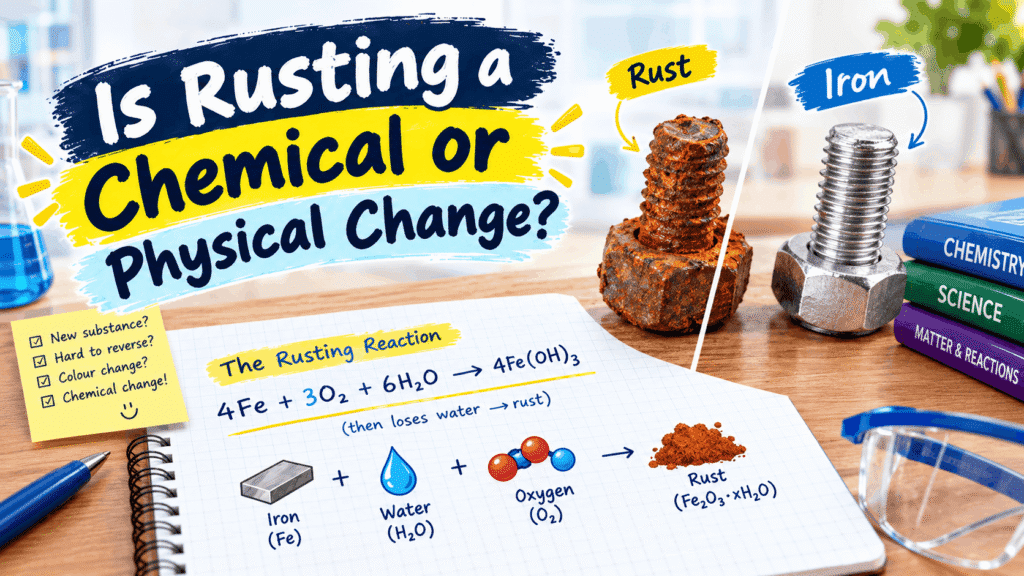
Rusting is a chemical change. Iron reacts with oxygen and water to form a new substance, hydrated iron(III) oxide, and that rust cannot simply turn back into iron.
Ever left a bike out in the rain and found orange-brown flakes on the chain a week later? That crust is the clue this whole question depends on. At TutorBoost, we help students across Ontario work through exactly this kind of science question, so here is the reasoning in plain language.
What Is Rusting?
Rusting is the slow reaction of iron or steel with oxygen and water that produces a reddish-brown solid called rust. It is the best-known type of corrosion.
If chemistry ideas like this feel slippery, our science tutoring pairs students with a tutor for 1-on-1 online sessions, and our online chemistry tutoring goes deeper on topics like reactions and equations.
What Is Rust Made Of?
Rust is mostly hydrated iron(III) oxide, written as Fe₂O₃·xH₂O. According to Britannica, it forms when iron reacts with oxygen in the presence of moisture.
It is a different compound from the iron it came from. That is why rust is brittle and flaky while iron is hard and strong.
What Do Iron and Steel Need to Rust?
Both oxygen and water. Iron kept in truly dry air barely rusts, because water helps electrons move between the iron and the oxygen.
Salt and acid speed things up. Dissolved salt helps charge travel through water, which is why cars rust faster on salted winter roads. Acid rain is hard on metal for a similar reason.
How Does Rust Form Step by Step?
Iron gives up electrons (oxidation) and oxygen gains them. The overall reaction is:
4Fe + 3O₂ + 6H₂O → 4Fe(OH)₃
The iron(III) hydroxide then loses some water and becomes rust. If balancing equations like this feels shaky, our guide on how to balance chemical equations walks through the method.
Oxidation is not unique to metals, either.
Why Is Rusting a Chemical Change?
A chemical change happens when atoms rearrange to form one or more new substances. Rusting passes that test in three ways.
A New Substance Forms
Iron is a shiny, strong metal. Rust is a dull, crumbly oxide with completely different properties.
A new substance means a chemical change. The same logic applies when milk sours and becomes more acidic, which we cover in is milk an acid or a base.
The Change Cannot Easily Be Reversed
Drying or sanding a rusty nail does not turn the rust back into iron. Reversing it takes another chemical reaction at high temperature, which is how iron is smelted from ore.
Soaking rust in vinegar loosens it, but that is a second reaction where the acid dissolves the rust. It does not rebuild the iron that was lost.
The Properties Change Permanently
Colour, hardness and strength all change. A rusted bolt snaps where a clean one would hold. Energy changes too. Rusting releases a little heat, too slowly to notice, though some disposable hand warmers use a faster version of the same reaction.
What Is the Difference Between a Chemical and a Physical Change?
A physical change alters shape, size or state while the substance stays the same, and a chemical change creates a new substance. Comparing the two makes the rusting answer easy to defend.
What Is a Physical Change?
Ice melting into water is the classic case. It is still H₂O, and it can freeze back again. Tearing paper or crushing a can are physical changes too. The material looks different but is not a new substance.
What Is a Chemical Change?
Look for a new substance, a gas, a permanent colour change, heat or light, and a change that is hard to undo. Rusting shows several of these at once.
Chemical vs Physical Change: Quick Comparison
| Change | New substance? | Easy to reverse? | Type |
| Rusting iron | Yes, iron oxide | No | Chemical |
| Melting ice | No, still H₂O | Yes, by freezing | Physical |
| Burning wood | Yes, ash and gases | No | Chemical |
| Tearing paper | No | Not really, but still paper | Physical |
Why Do Some Students Think Rusting Is a Physical Change?
The confusion comes from judging by what you can see on the surface instead of asking whether a new substance formed. It is a common mix-up, and it is one reason chemistry feels harder than it looks.
Does the Colour Change Prove It Is Physical?
No. A colour change alone settles nothing in either direction. The real test is whether a new substance formed, and here it did.
Is Scraping Off Rust the Same as Reversing It?
No. Sanding removes the rust, but the iron that became rust is gone. The nail is simply thinner than before.
Is Flaking Rust Just Surface Damage?
No. Each flake is new iron oxide, and the fresh metal underneath is exposed to air and water. The damage keeps going deeper.
How Can You Prevent Rusting?
Preventing rust means keeping iron away from oxygen, water or both. None of these methods is permanent, but each slows the reaction a lot.
Painting and Oiling
Paint and oil form a barrier that blocks air and moisture from reaching the metal. Scratches break that barrier, so coatings need upkeep.
Galvanizing
Galvanizing coats iron with zinc. Zinc reacts first, so it protects the iron even when the coating is scratched.
Stainless Steel
Stainless steel contains chromium, which forms a thin protective oxide layer on the surface. That layer keeps oxygen and water away from the iron underneath.
Frequently Asked Questions
Is rusting a physical change?
No. A physical change keeps the same substance, but rusting turns iron into iron oxide.
Can rust turn back into iron?
Not by drying or sanding. It takes another chemical reaction at high temperature, like the process used to smelt iron from ore.
Is rusting a fast or slow reaction?
Usually slow. Moisture, salt and acid make it faster.
Does salt make iron rust faster?
Yes. Dissolved salt helps charge move through water, which speeds up the reaction.
Is rusting the same as oxidation?
Rusting is the oxidation of iron, but not all oxidation is rusting. Aluminum oxidizes too, yet it forms a protective layer instead of rust.