You’re sitting in CS class. The teacher explains algorithms. Everyone nods. You’re nodding too, but internally? You’re completely lost. By the end of class, you’re convinced: Computer science is magic, and you’re just not a magic person.
Here’s the truth: That feeling isn’t a sign you can’t learn CS. It’s completely normal. At TutorBoost, we’ve helped hundreds of students move through this exact phase. There’s a system to fix it.
Why Does Computer Science Feel So Impossible?
Computer Science feels impossible because you’re doing something your brain has never done before. You’re not broken. Your brain is working exactly as it should, it’s adapting to something completely new.
When you learn math, you build on knowledge you already have. Algebra extends kindergarten addition. Your brain has a framework.
When you learn CS, your brain gets no framework. You’re building a completely new way of thinking. The confusion you’re feeling? That’s your brain building new neural pathways. It feels impossible because it genuinely is different from anything you’ve learned before.
Many students are struggling with other sciences and technology concepts. CS is no different, it’s just a new challenge your brain hasn’t encountered yet.
What Are the 3 Specific Reasons CS Feels Impossible?
Three things make CS harder than other subjects. Understanding these stops you from blaming yourself.
Your Brain Has No Foundation
Math introduces concepts slowly over years. CS? It’s introduced “cold.” On day one, you’re learning variables, loops, and logic simultaneously.
It’s like being dropped into a foreign country where nobody speaks English. Everyone seems fine navigating. You’re lost. That’s not because you’re bad at languages. You have no context yet.
The Syntax Is Merciless
One missing semicolon. One typo. Your entire program breaks.
In math, a small error might earn partial credit. CS doesn’t care. One character wrong, and nothing works.
This requires attention to detail most subjects don’t demand. Every character matters. Each programming language (Python, Java, C++) has different rules too. The syntax varies. Your brain learns not just one language but multiple rule systems.
Everything Builds on Everything Else
CS is cumulative. If you skip one concept, everything after becomes exponentially harder.
Miss variables? Functions become impossible. Don’t understand functions? Classes are a nightmare. Fall behind, and catching up becomes brutal because each new concept assumes you mastered the last one.
This constructive discipline is what makes CS fundamentally different from most other subjects.
Why Does Every Student Feel This Way?
Here’s what nobody tells you: Every programmer felt exactly like this. The best coders in the world started confused. The difference? They kept going.
Your struggle isn’t evidence of inability. It’s evidence of growth. When your brain learns something new, it feels uncomfortable. That discomfort is your neural pathways adapting.
Think about learning to ride a bike. It felt impossible for weeks. Then one day, it clicked. Your brain adapted. Suddenly, you couldn’t understand why it was ever hard.
CS is the same. You’re in the “it feels impossible” phase. That phase is temporary. With consistent practice, it transforms into competence.
Most students quit when confused, assuming they’re not cut out for CS. But if they’d pushed through two more weeks? Everything would have shifted.
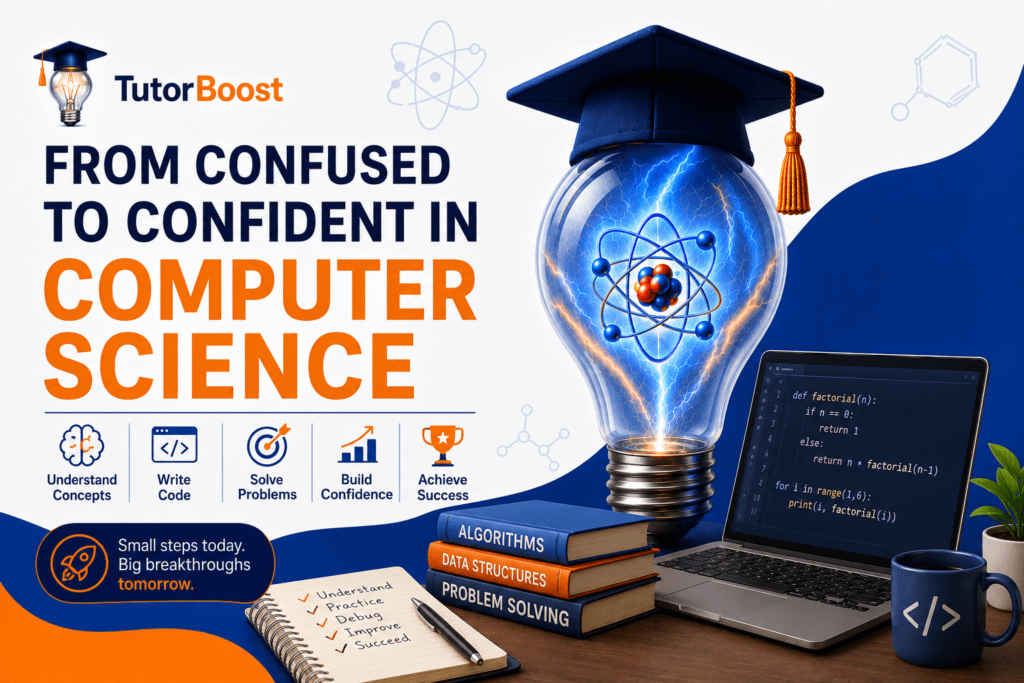
How Do You Actually Fix It? (The 5-Step System)
CS feels impossible because you’re trying to learn too much at once. Here’s the system that transforms confusion into competence.
Stop Memorizing, Start Understanding
You don’t need to remember every syntax rule. You need to understand why things work.
Focus on patterns, not details. Use error messages as guides. Professional programmers Google basic stuff constantly. Stop trying to be perfect. Debugging isn’t punishment, it’s how professionals learn too.
Break Problems Into Smaller Pieces
Don’t solve entire programs at once. Write five lines. Test them. Make sure they work. Then write five more.
Celebrate small wins. A working loop? That’s victory. A functioning function? Progress. These wins build confidence, exactly what computer science tutoring helps reinforce.
Embrace Debugging As Learning
When code breaks, that’s when learning happens fastest. Each error fixed teaches something. Eventually, you know enough wrong ways that the right way becomes obvious.
Professional developers spend hours debugging. It’s not failure. It’s the job.
Practice Daily (Not Marathon Sessions)
One hour every day beats five hours once a week. Your brain needs consistent exposure to absorb concepts.
Even 30 minutes daily accelerates progress more than sporadic longer sessions.
Explain It to Someone Else
If you can’t explain a concept simply, you don’t understand it yet. Teaching forces clarity.
Find a study partner. Ask questions in class. When you articulate what you don’t understand, you often figure it out.
What Myths Are Holding You Back?
- “If I don’t understand immediately, I can’t learn CS.” False. Understanding takes time. Your brain needs weeks to build new neural pathways.
- “Everyone else gets it except me.” False. Everyone struggles. The students who look confident? They’re just better at hiding it.
- “I need to be naturally good at math.” False. Logic skills matter more than math ability. Many excellent programmers weren’t math stars.
- “You’re either born for CS or not.” False. It’s practice and persistence, not talent. Talent is rare. Persistence is common.
When Should You Get Professional Help?
If you’ve been struggling with science concepts and CS feels impossible despite your effort, getting expert help isn’t giving up. It’s strategy.
A tutor from TutorBoost helps by explaining concepts in ways that match your learning style. Generic lectures don’t work for everyone. Personalized explanation does.
A tutor breaks complex ideas into smaller pieces and provides immediate feedback. You know right away if you’re on the right track. Confidence builds with every small win.
Getting help accelerates your timeline significantly, saving weeks of frustration. If you’re stuck for more than a few days, TutorBoost computer science tutoring can unstick you fast.
Final Thoughts
Computer Science feels impossible right now. But in 3-4 weeks of consistent practice, maybe with support from TutorBoost, you’ll notice something shift.
The concepts that were mysterious start making sense. The code that broke now works. CS doesn’t feel impossible anymore. It feels like a language you’re learning. That moment is coming. Keep going.
FAQs
What Programming Language Should I Start With?
Start with Python, it’s designed to be human-readable and forgives syntax errors better than other languages. Once you understand concepts in Python, learning Java, C++, or JavaScript becomes much easier because you already understand the logic underneath.
How Do I Deal With Imposter Syndrome (Feeling Like a Fraud)?
Every programmer feels like a fraud at some point, this is so common it has a name. Remember: struggling doesn’t mean you don’t belong; it means your brain is growing. Share your doubts with a study group or tutor who can remind you of your actual progress.
What If I Fail a CS Exam or Quiz?
One failed exam doesn’t define your ability. Use it as diagnostic feedback to identify exactly which concepts need more practice, then work through those specific areas. Many successful programmers failed early assessments before mastering the material.
Is Coding the Same as Computer Science?
No, coding is writing programs; computer science is the theory behind how programs work (algorithms, data structures, logic). You can be a good coder without deep CS understanding, but understanding CS makes you a much better coder. TutorBoost teaches both.
How Do I Stay Motivated When Progress Feels Slow?
Track small wins: “I fixed a bug,” “I wrote a loop without help,” “I understood this concept today.” Progress in CS feels invisible until suddenly it clicks, so celebrate micro-progress to maintain momentum through the slow weeks.