
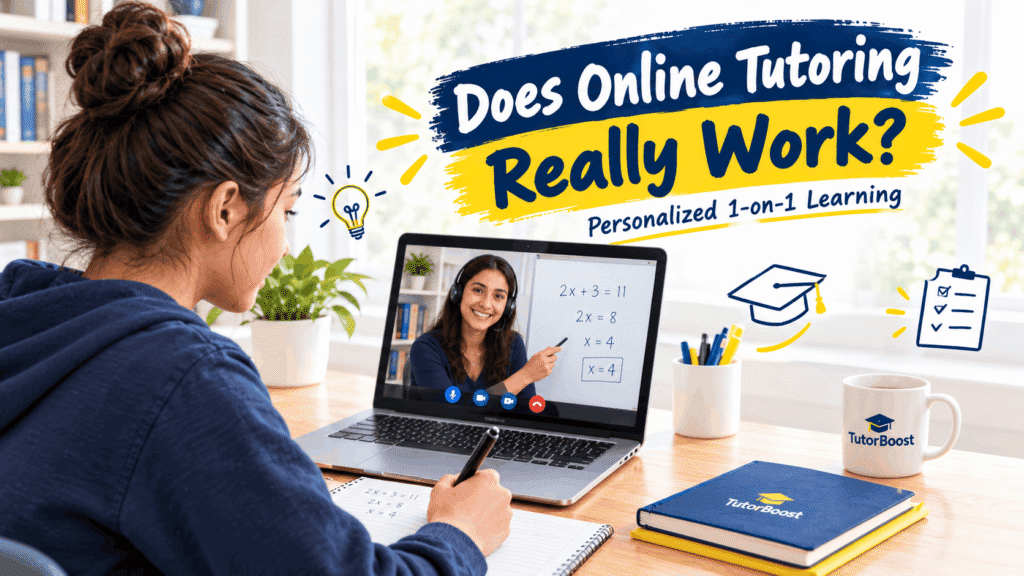
Online tutoring can work very well when sessions are live, personalized, and focused on the student’s actual learning gaps. The format alone is not what makes tutoring effective. The tutor needs to identify where the student is stuck, explain it clearly, let the student practise, and track whether they can eventually work independently.
At TutorBoost, 1-on-1 online tutoring is built around that idea. Students work directly with a tutor rather than simply watching lessons or completing another set of generic exercises.
Does Online Tutoring Really Work?
Online tutoring works when it leads to better understanding, fewer repeated mistakes, stronger independent problem-solving, and eventually better academic performance.
Research supports the potential of well-designed online tutoring. A randomized study of secondary-school Math tutoring found improvements in test scores and end-of-year grades, while other recent research shows that results can vary depending on the program, student participation, and how tutoring is delivered. So the more useful question is not simply, “Does online tutoring work?”
It is:
What makes online tutoring work for this student?
What Makes 1-on-1 Online Tutoring Effective?
One-to-one tutoring gives the tutor time to observe how a student thinks rather than teaching everyone at the same pace.
That makes it easier to identify the real problem instead of repeatedly reviewing the current homework.
Does the Tutor Find the Actual Learning Gap?
A student struggling with quadratics may actually have weak factoring skills. A Chemistry student confused by equilibrium may still be shaky with earlier calculations. Effective tutoring works backward when necessary.
That is also why tutor quality matters. Parents comparing options can use how to find a quality online tutor in Canada to check subject experience, teaching style, communication, and fit.
Does the Student Actually Do the Work?
A good online tutor should not spend the whole session solving questions while the student watches. Students need to answer, explain, calculate, write, make mistakes, and correct those mistakes. The tutor provides guidance, but the goal is independent learning.
What Should Happen During a Good Online Tutoring Session?
An effective session should have a clear learning purpose rather than becoming an hour of unfinished homework.
A simple structure is:
Diagnose → Explain → Practise → Check → Plan
How Does the Tutor Diagnose the Problem?
The tutor may review a recent test, ask the student to solve a question, or listen to how they explain a concept. The point is to find the exact step where understanding breaks down.
How Should Practice Work?
After explaining the concept, the tutor can work through one example with the student before gradually giving them more responsibility. By the end, the student should attempt something independently. That final check tells the tutor whether the lesson actually worked.
What Should Parents Expect From the First Online Tutoring Session?
The first session should help establish the student’s starting point, current struggles, goals, and whether the tutor is a good match. Some teaching should happen, but the tutor also needs to understand what the student already knows and what has not been working.
Parents who are still choosing support can also use the questions in Online Tutor Needed before committing to regular sessions.
How Does Online Tutoring Work for Math, Science and English?
The technology may be similar across subjects, but the teaching should not look identical.
Math, Science, and English require different kinds of thinking, so effective online tutoring should change with the subject.
How Does Online Math Tutoring Work?
In Math, students need to show their working rather than only give an answer. An interactive whiteboard allows the tutor to see each step, identify where the method goes wrong, and correct the mistake immediately.
TutorBoost’s online Math tutoring for Ontario students follows the student’s actual course, from foundational Math through MHF4U, MCV4U, and other senior courses.
How Does Online Science Tutoring Work?
Science tutoring may involve diagrams, equations, calculations, processes, graphs, or concept explanations depending on whether the student is studying Biology, Chemistry, or Physics.
The tutor should help the student connect the concept to the problem instead of simply giving them another definition to memorize.
TutorBoost’s online tutoring services include Science, Chemistry, Physics, Biology, Math, English, and other subjects.
How Does Online English Tutoring Work?
English sessions may involve reading a passage together, planning an argument, improving paragraph structure, selecting evidence, or editing a piece of writing. Shared documents allow the tutor and student to examine writing in real time.
Does Online Tutoring Improve Grades?
Online tutoring can support better grades, but marks are usually the result of a process rather than one session.
The progression often looks like:
better understanding → fewer mistakes → more independent work → stronger assessments
Parents should therefore look for early signs of progress before expecting a major report-card change.
What Should Improve Before the Grade Does?
Students may begin completing homework with less help, making fewer repeated mistakes, explaining concepts more clearly, or approaching difficult questions with greater confidence. Those changes matter because they show that the student is becoming less dependent on the tutor.
How Long Does It Take for Online Tutoring to Work?
There is no honest universal answer. A student with one missed concept may improve quickly. Someone rebuilding several years of foundational gaps may need consistent support over a longer period.
Progress depends on the subject, size of the gap, frequency of tutoring, quality of instruction, and practice between sessions. Be cautious of anyone promising a specific grade increase within a fixed number of lessons.
How Often Should Your Child Have Online Tutoring?
Tutoring frequency should match the academic goal rather than follow one rule for every student.
Weekly tutoring may be enough for ongoing support or one recurring weak area. More frequent sessions can make sense when a student has fallen behind significantly or is preparing for an important assessment. The schedule should be reviewed as the student improves.
Is Online Tutoring Effective for High School Students?
Online tutoring can be especially useful for high school students because subjects become more specialized and earlier learning gaps start affecting later courses.
A Grade 11 Math weakness, for example, can become a Grade 12 problem when a new course assumes those skills are already secure.
Curriculum knowledge matters here. Canadian curriculum tutoring online can help students work on the material and expectations they actually encounter in school rather than following a generic program.
When Might Online Tutoring Not Work Well?
Online tutoring is less effective when the student remains passive, sessions are generic, attendance is inconsistent, or the tutor does most of the work.
Poor tutor-student fit can also matter.
If the same misunderstanding keeps appearing, the student cannot solve anything independently, or there is no clear progress plan, the approach may need to change.
The answer is not always “more tutoring.” Sometimes the tutor, frequency, or lesson focus needs adjusting.
How Can Parents Help Online Tutoring Work Better?
Parents do not need to sit beside the student throughout every lesson.
A quieter study space, reliable internet, relevant class materials, and consistent attendance are usually more helpful.
Parents can also share recent tests or teacher feedback and periodically ask what the tutor is working on and what progress has been made. The student should still do the learning themselves.
When Does 1-on-1 Online Tutoring Make the Most Sense?
One-to-one tutoring is especially useful when a student needs targeted help rather than another general lesson.
That may be when classroom explanations are not clicking, a specific subject is falling behind, homework takes far too long, or the student understands examples but cannot solve new questions independently.
Personalized support allows the tutor to focus on exactly what the student needs instead of spending time on material they already understand.
What Should Parents Expect From Effective Online Tutoring?
A useful way to remember it is:
Target → Teach → Practise → Track
Target the real learning gap. Teach it in a way the student understands. Practise until they can apply it independently. Track whether the same problem is actually improving.
Online tutoring works best when it is personalized, interactive, consistent, and focused on making the student more independent over time.
Frequently Asked Questions
Does online tutoring really work?
Yes, it can. Results are strongest when tutoring is targeted, interactive, consistent, and matched to the student’s actual learning needs.
Is online tutoring as effective as in-person tutoring?
It can be, especially for academic subjects that work well with live video, digital whiteboards, shared documents, and real-time feedback.
Can online tutoring improve grades?
It can support better grades by improving understanding, correcting learning gaps, and helping students work more independently.
How often should my child have online tutoring?
Frequency depends on the student’s goals and learning gaps. Weekly support may suit some students, while others may temporarily need more frequent sessions.
How do I know if online tutoring is working?
Look for fewer repeated mistakes, greater independence, clearer understanding, improved confidence, and eventually stronger homework, tests, and grades.