
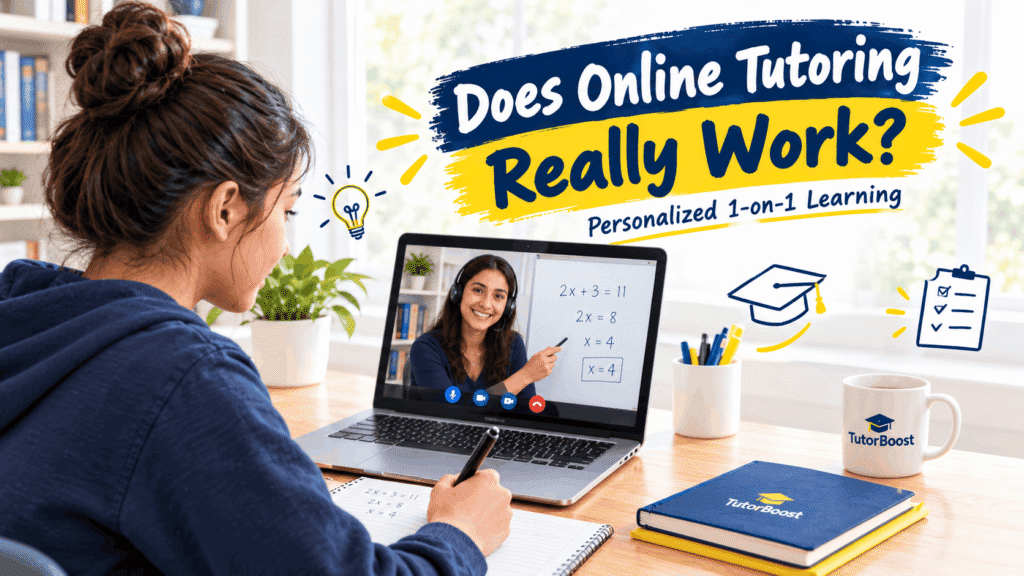
Online tutoring can work very well when sessions are live, personalized, and focused on the student’s actual learning gaps. What makes it effective is not simply being on a video call. The tutor needs to identify where the student is stuck, explain the concept clearly, guide practice, and check whether the student can eventually work independently.
At TutorBoost, 1-on-1 online tutoring is built around that kind of targeted support. Students work directly with a tutor who can adjust the lesson to their subject, grade, pace, and current difficulties instead of following one generic program.
Does Online Tutoring Really Work?
Yes, online tutoring can be effective, but the quality of the tutoring matters more than the format alone.
Progress may first appear as better understanding, fewer repeated mistakes, stronger confidence, and more independent problem-solving. Better grades can follow, but they are usually the result of those earlier improvements rather than an instant outcome.
A good online tutor should therefore be judged by how well they understand the student’s needs and adapt their teaching. If you are still comparing options, knowing what to look for in a quality online tutor can help separate subject expertise and effective teaching from a polished profile.
What Makes 1-on-1 Online Tutoring Effective?
One-to-one tutoring gives the tutor time to watch how one student thinks.
Instead of simply seeing that an answer is wrong, the tutor can identify the exact step where the reasoning breaks down.
A student struggling with quadratics, for example, may actually have weak factoring skills. A Chemistry student struggling with equilibrium may have an earlier gap in calculations or foundational concepts.
The goal is to address the cause, not repeatedly review the latest worksheet.
Does the Student Need to Be Active During the Session?
Yes. Effective online tutoring should involve the student answering questions, solving problems, explaining ideas, making mistakes, and correcting them.
If the tutor does all the talking and solving, the student may understand while watching but still struggle when working alone.
How Does Online Tutoring Work for Different Subjects?
The online platform may be the same, but a good tutoring session should change according to the subject.
Math, Science, and English require different skills, so the tutor should adjust the activities rather than use one teaching method for everything.
How Does Online Math Tutoring Work?
Math tutoring should make the student’s thinking visible. With online Math tutoring for Ontario students, students can work through equations and problems step by step while the tutor watches where the method starts to go wrong.
An interactive whiteboard is especially useful because the tutor can see the working, ask why a step was chosen, and correct the misunderstanding before it becomes a repeated habit.
How Does Online Science Tutoring Work?
Science tutoring often combines conceptual understanding with calculations, diagrams, graphs, equations, and problem-solving.
A Biology student may need help connecting processes. A Chemistry student may need to understand why a reaction happens. A Physics student may understand a formula but struggle to recognize when to use it.
TutorBoost’s Science tutoring and other online tutoring services allow the support to match the actual subject rather than treating every Science course the same way.
Why Does Curriculum Alignment Matter?
Tutoring is more useful when it supports what the student is actually learning at school.
For Canadian students, curriculum-aligned online tutoring helps connect sessions with current course expectations, assignments, assessments, and prerequisite knowledge instead of introducing an unrelated learning sequence.
What Should Happen During a Good Online Tutoring Session?
A productive session should have a clear purpose rather than becoming an hour of unfinished homework.
A useful structure is Diagnose → Explain → Practise → Check → Plan.
The tutor first identifies what the student understands and where the difficulty begins. The concept is then explained in a way that makes sense to that student.
Next, tutor and student work through examples together before the student tries something independently. The final step is deciding what still needs practice before the next session.
That independent check is important. It shows whether the student actually learned the skill rather than simply following the tutor.
What Should Parents Expect From the First Online Tutoring Session?
The first session should establish the student’s starting point, immediate learning goals, and whether the tutor is a good match. The tutor might look at a recent test, class notes, homework, or ask the student to solve several questions.
Some teaching should happen during the first lesson, but the tutor also needs enough information to understand why the student is struggling.
Parents who have not chosen a tutor yet can use the questions in Online Tutor Needed? Questions to Ask Before You Hire One to check experience, teaching methods, progress tracking, and trial policies before committing.
Does Online Tutoring Improve Grades?
Online tutoring can support better grades, but the process usually begins before the report card changes.
The sequence is often:
better understanding → fewer mistakes → greater independence → stronger assessment performance
A student may begin completing homework with less help, explaining concepts more clearly, or making fewer repeated errors before a major grade improvement becomes visible. Those early changes are useful signs that tutoring is moving in the right direction.
How Long Does It Take for Online Tutoring to Work?
There is no reliable universal timeline. A student who missed one key concept may improve relatively quickly. Someone rebuilding several foundational gaps may need consistent support over a longer period.
Progress depends on the subject, size of the learning gap, session frequency, student participation, and what happens between lessons.
Parents should be cautious of tutoring providers that promise a specific grade increase within a fixed number of sessions.
How Often Should a Student Have Online Tutoring?
The right frequency depends on why the student needs tutoring. Weekly sessions may work well for ongoing course support or one recurring weak area. A student who has fallen significantly behind or is preparing for an important exam may temporarily need more support.
The frequency should change as the student becomes more independent rather than continuing automatically at the same level.
What Should Students Do Between Tutoring Sessions?
Tutoring works better when students use what they learned between sessions. That might mean redoing a question they originally missed, practising a similar problem, reviewing feedback, or testing themselves without notes.
A realistic study plan for Math, Science and English can help students turn tutoring into continued practice instead of relying on the next session to do all the learning. The tutor should support independent study, not replace it.
When Might Online Tutoring Not Work Well?
Online tutoring becomes less effective when lessons are generic, attendance is inconsistent, the student stays passive, or the tutor completes most of the work.
Poor tutor-student fit can also matter.
If the same misunderstanding continues for weeks, there is no clear progress plan, or the student still cannot attempt questions independently, something should change.
That may mean changing the teaching approach, session frequency, learning goals, or tutor.
How Can Parents Tell Whether Online Tutoring Is Working?
Do not look only at grades. Ask whether your child is making fewer repeated mistakes, completing work with less help, explaining ideas more clearly, and showing more confidence when approaching unfamiliar questions.
Parents can also ask the tutor what has improved, what remains difficult, and what the next learning goal is. A good tutor should be able to answer those questions clearly.
When Does 1-on-1 Online Tutoring Make the Most Sense?
One-to-one tutoring is especially useful when the student needs targeted help instead of another general lesson.
That may happen when classroom explanations are not clicking, one subject is falling behind, homework consistently takes too long, or the student understands examples but cannot solve new questions independently.
The advantage of personalized tutoring is that time can be spent on the exact learning gap rather than material the student already understands.
What Should Parents Expect From Effective Online Tutoring?
A simple way to remember the process is:
Target → Teach → Practise → Track
Target the real learning gap. Teach the concept in a way the student understands. Practise until the student can apply it independently. Track whether the difficulty is actually improving.
Online tutoring works best when it makes the student progressively less dependent on the tutor, not more.
Frequently Asked Questions
Does online tutoring really work?
Yes. It can be effective when sessions are personalized, interactive, consistent, and targeted to the student’s actual learning needs.
Is online tutoring as effective as in-person tutoring?
It can be. Live video, digital whiteboards, screen sharing, and shared documents allow many academic subjects to be taught interactively online.
Can online tutoring improve grades?
It can support better grades by improving understanding, closing learning gaps, and helping students complete work more independently.
How often should my child have online tutoring?
The right frequency depends on the subject, size of the learning gap, upcoming assessments, and how much practice happens between sessions.
How do I know if online tutoring is working?
Look for fewer repeated mistakes, better understanding, greater independence, improved confidence, and eventually stronger performance on assignments and assessments.