
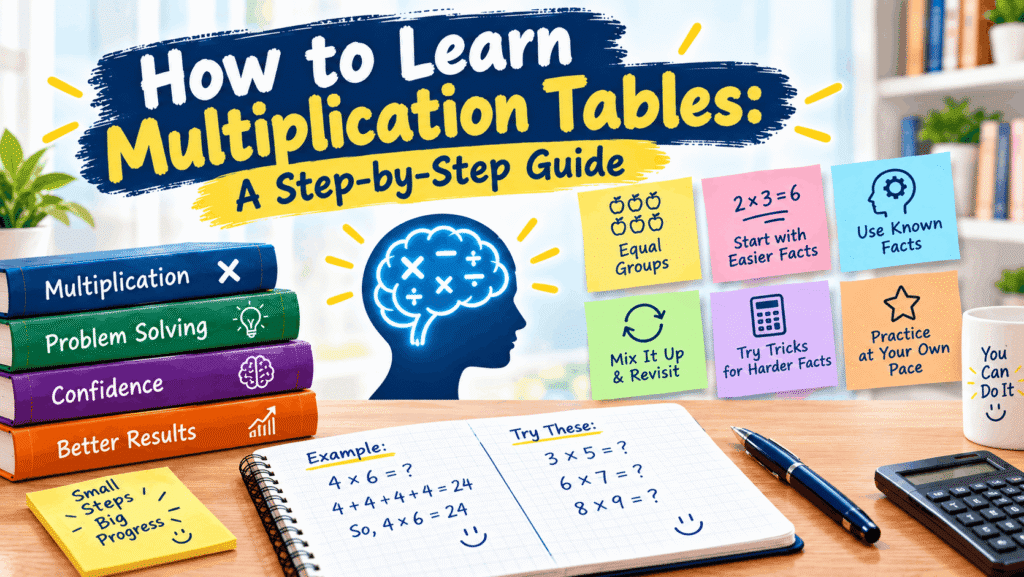
To learn multiplication tables, start with equal groups, practise the easier facts, and use known answers to work out unfamiliar ones. Then revisit those facts in a different order so you can remember the answers without reciting an entire table.
At TutorBoost, students can receive personalised support with foundational maths. For parents practising at home, the starting point is simple: help your child understand what multiplication means before asking them to remember every answer.
This guide explains how to learn times tables, handle harder multiplication facts and practise at a pace that suits your child.
What Should Children Understand Before Learning Times Tables?
Children should understand multiplication as equal groups before memorising multiplication tables. For example, three bags containing four apples each give three groups of four: 3 × 4 = 12.
Use counters, blocks or drawings to make that relationship visible. Arrange 12 counters into three rows of four. This rectangular arrangement is called an array.
Connect the picture to repeated addition: 4 + 4 + 4 = 12. Ask your child to explain how the groups, addition and multiplication equation describe the same total. Introduce the words naturally. The numbers being multiplied are factors, and the answer is the product.
Which Multiplication Tables Should You Learn First?
A useful starting order is the zero and one facts, followed by the 2, 10 and 5 times tables. After that, introduce other tables through connections your child already understands. There is no single order every learner must follow.
How Do the Zero and One Facts Work?
Multiplying a number by zero gives zero. Four groups with nothing in each group still contain nothing: 4 × 0 = 0. Multiplying by one leaves the number unchanged. One group of eight contains eight objects, so 1 × 8 = 8.
These facts are easy to overlook, but they belong in practice alongside the other tables.
Why Start With the 2s, 10s and 5s?
The 2 times table connects to doubling: 2 × 7 means 7 + 7, giving 14. The 10 times table connects to place value. Six groups of ten make six tens, so 6 × 10 = 60.
The 5 times table can connect to the 10s. If 10 × 8 = 80, then five groups of eight are half as many, giving 5 × 8 = 40.
Skip counting helps children explore these patterns. However, gradually practise individual questions so they do not need to start counting from the beginning each time.
How Can Known Facts Help With Harder Multiplication Tables?
Known facts give children a way to calculate an answer they cannot yet recall. Doubling, reversing factors and breaking numbers apart make unfamiliar facts more manageable.
How Does Doubling Help?
To multiply by four, double the other number twice. For 4 × 6, double six to get 12, then double 12 to get 24. For the 8 times table, double a known 4s fact. Since 4 × 7 = 28, twice that amount gives 8 × 7 = 56. For the 6s, double the matching 3s fact. If 3 × 8 = 24, then 6 × 8 = 48.
Why Can You Reverse the Factors?
Changing the order of the factors does not change their product. This is the commutative property: 7 × 4 and 4 × 7 both equal 28.
An array helps explain why. Turn four rows of seven counters around, and you can see seven rows of four.
Learning these connections reduces the number of separate answers a child needs to memorise.
How Do You Break Apart a Difficult Fact?
Split an unfamiliar multiplication into easier parts. For 7 × 6, use five groups of six and two more groups of six: 30 + 12 = 42.
This is an example of the distributive property. Children do not need to memorise the name immediately; they need to understand why combining the smaller groups gives the correct total.
What Tricks Help With the 9, 11 and 12 Times Tables?
Useful multiplication tricks should have clear limits and a mathematical explanation. They can help children find answers while recall develops.
What Is the Nine Times Table Trick?
Multiply by ten, then subtract one group. For 9 × 8, calculate 10 × 8 = 80, then subtract eight to get 72.
The finger trick also works for 9 × 1 through 9 × 10. Hold up ten fingers and fold down the eighth finger for 9 × 8. Seven fingers remain to its left and two to its right, representing 72.
Be careful with the digit-sum rule. The digits of the products from 9 × 1 through 9 × 10 add to nine, but this does not hold directly for every multiple of nine. For example, 9 × 11 = 99, whose digits add to 18.
How Do the 11s and 12s Work?
For 11 multiplied by a whole number from one to nine, repeat that number’s digit: 11 × 6 = 66. This shortcut does not extend unchanged to 11 × 12.
For the 12 times table, split 12 into ten and two. To solve 12 × 7, calculate 70 + 14 = 84. The same method handles 12 × 12: 120 + 24 = 144.
How Should Children Practise Multiplication Tables at Home?
Use short, manageable sessions that include explanation, recall and correction. A five-minute session is a practical starting point, which you can adjust to your child’s attention and confidence.
Begin with a few familiar facts. Introduce one or two less secure facts using a drawing or a known answer. Then hide the answers and ask your child to retrieve them.
If an answer is incorrect, work through the reasoning together. Ask the question again after a few other questions and revisit it on another day.
Flashcards can support this routine. Have your child say the full equation rather than only the answer. Keep a small set of facts needing practice, while occasionally reviewing secure ones.
Mix the questions as confidence grows. A child who can recite the 6 times table may still need practice answering 6 × 8 without saying every earlier fact.
For a game, turn over two number cards and multiply them. Take turns explaining answers instead of racing. Standard six-sided dice only cover factors from one to six, so use cards numbered up to 12 when practising larger facts.
What Should Ontario Students Know by Grade?
Ontario’s curriculum builds multiplication-fact knowledge across Grades 3, 4 and 5. It expects students to recall facts and demonstrate their understanding, alongside related division facts.
In Grade 3, students work on multiplication facts for 2, 5 and 10 and their related division facts.
In Grade 4, the expectation expands to facts from 1 × 1 through 10 × 10 and related division facts.
By Grade 5, students are expected to recall and demonstrate facts from 0 × 0 through 12 × 12 and related division facts. Parents can consult the Ontario mathematics curriculum for the full expectations. Connect multiplication and division during practice. Knowing 6 × 7 = 42 helps with both 42 ÷ 6 = 7 and 42 ÷ 7 = 6. Division by zero is undefined, so do not apply that reversal to zero facts.
When Might a Child Need Extra Help With Multiplication?
Extra support may help when a child repeatedly struggles to represent equal groups, forgets facts despite regular practice, or becomes distressed during maths homework.
Slow answers alone do not explain the difficulty. Notice whether your child understands the question, has a useful strategy and can explain their thinking.
Speak with their teacher about what they observe in class. For targeted support, TutorBoost’s one-on-one tutoring services offer personalized instruction that can focus on foundational maths.
The aim is steady progress: understanding the facts, finding answers accurately and gradually recalling more of them independently.
What Else Do Parents Ask About Learning Multiplication Tables?
These quick answers address common questions about practice and expectations.
What Is the Easiest Way to Learn Multiplication Tables?
Start with equal groups and easier facts, then use doubling and related facts for harder questions. Practise recalling answers in mixed order.
How Long Does It Take to Learn Times Tables?
There is no fixed timeline. Adjust practice to the child’s starting knowledge and revisit facts across different days.
Is It Okay to Use Fingers When Multiplying?
Yes. Fingers can support early understanding and some strategies. Gradually develop other methods and independent recall without shaming their use.
Should Children Learn Tables Up to 10 or 12?
Follow classroom expectations. In Ontario, Grade 4 covers facts through 10 × 10, while Grade 5 extends through 12 × 12.
Should Multiplication Practice Be Timed?
Begin with understanding and accuracy. If a timer causes distress or guessing, use untimed questions and discuss how the child finds each answer.