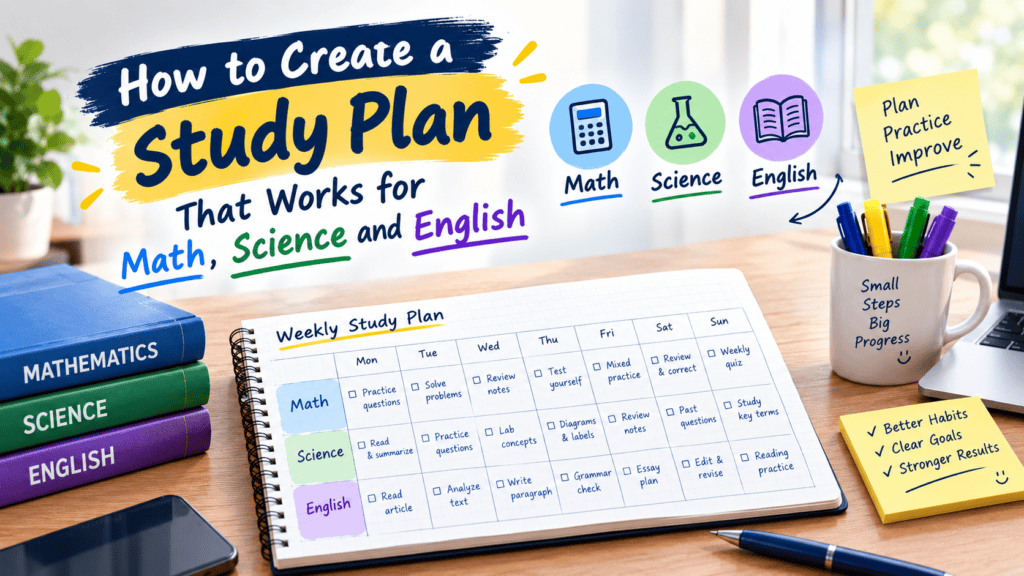
A good study plan does more than divide your week into Math, Science, and English. It tells you what to study, how to practise it, when to revisit it, and which subjects deserve more attention right now.
That distinction matters because the same study method won’t work equally well for every subject. Math depends heavily on problem-solving, Science combines understanding with application, and English improves through reading, analysis, and writing.
At TutorBoost, personalized learning starts with recognizing those differences. Your weekly study schedule should do the same, rather than giving every subject identical study blocks.
What Makes a Study Plan Actually Work?
An effective study plan connects your academic goals to specific tasks and realistic study sessions, built around two well-tested learning principles: active recall, testing yourself instead of rereading notes, and spaced repetition, revisiting material after a gap instead of cramming it once.
Instead of scheduling “Math for one hour,” decide what you need to accomplish during that hour. The same applies to Science and English. A useful plan should account for weak topics, current lessons, homework, assignments, test dates, revision, practice questions, and time to correct mistakes, with enough flexibility for topics that take longer than expected.
How Do You Decide What to Study First?
Start by identifying what actually needs attention instead of dividing your time equally between subjects.
List upcoming tests, assignments, current units, and concepts you cannot yet complete independently. Then classify each topic as strong, developing, or weak. Weak and time-sensitive material usually deserves more study time, especially in cumulative subjects where missing an earlier concept makes every concept after it harder to follow.
Should Math, Science and English Be Studied the Same Way?
No. You can organize all three subjects within one weekly study plan, but the activities inside each session should reflect the skills that subject requires.
How Should You Study Math?
Math study time should involve solving problems, not simply reviewing worked examples. Try questions without looking at the solution, show your complete working, identify where mistakes occurred, and redo incorrect problems later.
For topics where choosing the right method is part of the challenge, practice should include that decision-making. When working with trigonometry, for example, learning how to prove trigonometric identities step by step requires recognizing patterns and choosing an appropriate starting point rather than memorizing one fixed procedure.
A vague task such as “study Math” therefore becomes something measurable: “solve 10 mixed problems and redo every question I get wrong.”
How Should You Study Science?
Science study sessions should combine recall, conceptual understanding, and application. Start by explaining a process or concept without your notes, then use diagrams, calculations, practice questions, or real examples to see whether you can apply what you remember.
The method varies within Science. Physics often combines mathematical reasoning with visualization; a topic such as placing ammeters and voltmeters correctly in circuit diagrams becomes easier when you understand what each meter measures instead of memorizing where the symbol goes.
Biology demands a different balance, since processes, terminology, structures, and systems need to be connected rather than memorized as isolated facts, which is one reason students can struggle with Biology even after spending hours on it.
Chemistry benefits from connecting abstract ideas to real examples rather than memorizing definitions or reactions in isolation. Seeing why fresh milk is slightly acidic gives the pH scale real-world context, and at a more advanced level, shows why the study method has to shift toward pattern recognition as the subject gets more complex.
How Should You Study English?
English needs regular reading, analysis, writing, and editing. A productive session might include analyzing a passage, identifying supporting evidence, planning a paragraph, writing it without assistance, and then editing for clarity, grammar, and structure. Instead of “study English,” schedule a task such as “analyze one passage and write one evidence-based paragraph.”
How Do You Turn Each Subject Into Specific Study Tasks?
Every study block should have a clear outcome. “Study Science” gives you no starting point. “Explain photosynthesis without notes and answer five application questions” does. “Review Math” can become “solve eight trigonometry questions and correct every setup error.” “Do English” can become “plan an essay introduction and write two body paragraphs.”
The more specific the task, the easier it becomes to start, measure your progress, and decide what belongs in your next study session.
How Should You Divide Study Time Between Subjects?
Your available study time should reflect your current needs rather than being split into equal thirds. A difficult Math unit may require several shorter practice sessions. Science may need more time before an upcoming test. English might temporarily become the priority when an essay deadline approaches.
This is also where interleaving helps, alternating between subjects within a week rather than blocking one subject for days at a time. Studying in shorter, mixed sessions tends to hold attention better and improve retention compared to marathon sessions in a single subject. Keep some contact with every important subject, but let the balance shift week to week. The goal isn’t equal time, it’s enough time where it’s most needed.
How Do You Build a Realistic Weekly Study Schedule?
Start with the hours already unavailable because of school, sleep, meals, extracurriculars, work, or family commitments. Only then schedule study sessions, ideally in blocks of roughly 45 to 90 focused minutes with a short break between them, since attention reliably drops off past that point.
Put demanding tasks into periods when you normally concentrate well. Complex Math problems, unfamiliar Science concepts, and essay writing usually require more focus than vocabulary review or checking notes.
A simple weekly calendar, digital or on paper, is enough to track this; the format matters far less than actually writing the plan down and checking it daily. Don’t fill every free minute. Buffer time gives you somewhere to move unfinished work when an assignment takes longer than expected.
What Should Each Study Session Include?
A simple structure is Recall → Learn → Apply → Review. Recall what you already know before opening your notes. Learn or clarify the part that’s still unclear. Apply it through a problem, explanation, diagram, analysis, or piece of writing. Then review mistakes before ending the session.
For Math, application means solving. For Science, it may mean explaining, drawing, calculating, or answering application questions. For English, it means analyzing and producing writing. This turns studying from passive review into something you can actually test, and it’s the same active recall and spaced repetition logic behind the whole plan, applied one session at a time.
How Can Mistakes Improve Your Study Plan?
Mistakes are useful because they show you what should appear in next week’s schedule. Keep a simple error log containing the topic, what went wrong, why it happened, and what you need to practise again.
A repeated Math error may reveal a missing method. A Physics diagram mistake may show the underlying concept is unclear. In English, repeated feedback about weak evidence or paragraph structure should become a specific writing task. Your study plan should change as your weaknesses change.
How Do You Know If Your Study Plan Is Working?
Don’t judge your plan only by the number of hours you studied. Look for evidence that you can solve more Math questions independently, explain Science concepts without notes, make fewer repeated mistakes, and produce clearer English writing.
If the hours keep increasing but performance doesn’t, changing the study method is usually more useful than adding more study time.
When Can Tutoring Fit Into Your Study Plan?
Tutoring becomes useful when one topic keeps consuming study time without becoming clearer, or when the same mistakes continue despite regular practice. Personalized Math, Science and English tutoring can help identify the exact gap behind that difficulty and turn broad goals into targeted work.
The tutor shouldn’t replace independent study. Ideally, tutoring clarifies what you can’t solve alone, while your weekly plan gives you repeated opportunities to practise that skill independently.
What Is the Simplest Study-Planning System to Follow?
Remember five steps: Assess → Prioritize → Plan → Practise → Review. Assess what you currently know. Prioritize weak and urgent material. Plan specific study tasks. Practise using methods suited to the subject. Review your results and adjust the following week’s schedule. A study plan works when it responds to your learning rather than simply filling a calendar.
FAQs
How do I create a study plan for multiple subjects?
List current topics and deadlines, identify your weakest areas, and assign specific tasks to realistic study blocks throughout the week.
Should I study Math, Science and English every day?
Not necessarily. The frequency should depend on current difficulty, deadlines, and how much continued practice each subject requires.
Which subject should I study first?
Start with difficult or high-priority work when your concentration is strongest, then use lower-energy periods for lighter review.
How long should each study session be?
There is no single ideal length. Choose enough focused time to complete a defined task, then take a break before concentration noticeably drops.
Is it better to study one subject or several subjects in a day?
Either can work, but mixing subjects can help keep your weekly workload balanced as long as every session has a specific purpose.