
Social studies feels like an impossible mountain of dates and facts. If you’re here, you’ve spent hours trying to memorize everything with little to show for it. But here’s the truth that changes everything: social studies isn’t about memorizing.
It’s about understanding connections. Once you shift this, everything transforms. At TutorBoost, we’ve worked with countless students who felt exactly this way, and they discovered the problem wasn’t them, it was the approach. Let’s fix that.
Why Does Social Studies Feel Like an Impossible Mountain of Facts to Memorize?
The real problem isn’t you. Social studies has massive amounts of information. You’re juggling history, geography, civics, and economics all at once. Unlike math with clear formulas, social studies is about interconnected ideas where everything relates to everything else.
When you memorize dates and names without understanding, you force your brain to work against its natural wiring. You treat information as random trivia instead of a connected story. Historical events, geographic patterns, and political systems aren’t separate puzzles.
They’re pieces of one bigger picture. The moment you understand connections, everything sticks, not because you memorized, but because you truly understand.
This is why struggling with social studies feels different from other subjects. In social studies, you need to think critically, make connections, and understand why people’s decisions shaped the world. Understanding this isn’t weakness, it’s how your brain actually works. This is the first step to changing everything.
What Are the 3 Biggest Myths Holding You Back?
“I need to remember every date and name” is the biggest trap. Social studies teachers test understanding, not trivia. When you shift from memorizing dates to asking “Why did this matter?” you realize you don’t need everything. You just need the story.
“Memorization is the fastest way to study” sounds true but it’s backwards. Information memorized quickly is forgotten just as fast. Research shows understanding-based learning sticks permanently. Yes, memorization feels faster upfront, but it’s actually the slowest route to real learning.
“Some people are just naturally good at social studies, others aren’t” is false. This skill is built, not inherited. The students who excel make connections. They relate topics to real life. You can do exactly the same thing.
How Do You Actually Study Social Studies Without Memorizing Everything?
Shift from isolated facts to connected understanding. Here’s the framework that works.
Tell the Story, Not Just the Facts. Your brain remembers narratives, not lists. When studying a historical event, ask “What was happening in people’s lives? What changed?” When you see the Industrial Revolution as a story of families moving to cities and communities transforming, details stick naturally.
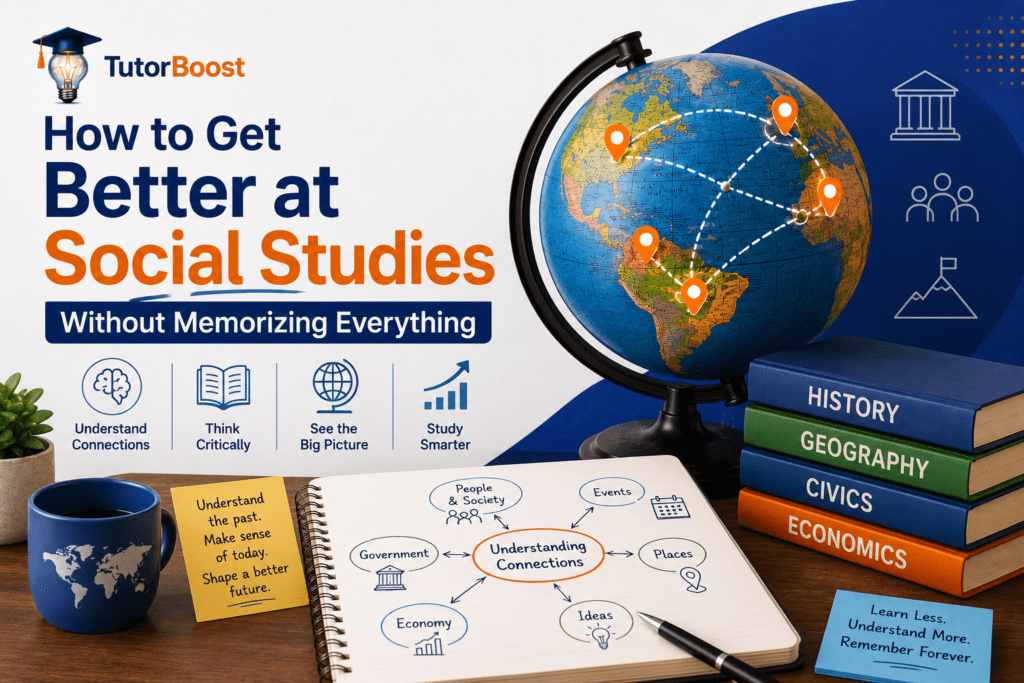
Map the Connections. Social studies is about relationships between events, ideas, and countries. Draw simple circles and arrows showing connections. For example: Trade routes → Economic power → Political conflict. Once you see these links, you’re understanding a system, not memorizing facts.
Use Visuals. Timelines, diagrams, and mind maps give your brain a skeleton to organize information. Simple boxes and arrows work perfectly. One visual per topic transforms overwhelming material into organized knowledge.
Test Yourself Weekly. Quiz yourself on concepts, not isolated dates. Retrieval practice is the most powerful learning technique. Weekly testing strengthens real retention far better than cramming.
Connect to Today’s World. Your brain prioritizes relevant information. When studying any historical event, ask “How does this show up in today’s news?” This makes social studies feel alive and current, not ancient history.
When Does It Actually Get Easier? The 4-Phase Timeline
One of the biggest frustrations is not knowing when to expect progress. Here’s the honest timeline.
The Confusion Phase (Weeks 1-2) feels slower because you’re building new pathways instead of taking memorization shortcuts. Your brain is working harder, which means it feels harder. That’s not a bad sign, it’s a sign of real learning happening. First tests might not show huge jumps yet, and that’s completely normal.
The Clarity Phase (Weeks 3-4) is where connections start appearing. Topics stop feeling like random facts. You catch yourself thinking “Oh, I get why this happened” instead of “What was the date?” You can explain concepts to a friend without notes. This is the week momentum builds, and at TutorBoost, we see this as the breakthrough moment where students realize the strategies are actually working.
The Application Phase (Weeks 5-8) brings real evidence of progress. You’re applying knowledge to new situations and essay questions. Test performance improves because you understand, not because you memorized. You catch yourself making connections without trying. Anxiety before tests drops noticeably.
The Mastery Phase (Weeks 8+) is where social studies stops feeling like a burden. You start feeling interested in current events because you understand the history behind them. This knowledge sticks permanently, not because you memorized, but because you truly understand.
Why Does Everyone Hit a Confidence Wall?
Even with right strategies, most students feel stuck at some point. You studied but didn’t get the grade expected. This is completely normal.
Understanding takes patience because your brain is building new pathways. Progress isn’t always linear. You might feel stuck one week, then everything clicks the next. You’re building understanding that lasts years memorizers forget within months.
Track what you CAN do. Can you explain concepts without notes? Spot connections? These are real progress signs even if grades haven’t jumped. Give yourself 2-3 more weeks of consistent effort before judging results. If frustration stays high after that, consider talking to your teacher. Sometimes struggling with other subjects just needs outside expertise to unlock.
When Should You Consider Getting Professional Help?
Here’s how to know when expert support can accelerate your understanding.
Red Flag #1: You’re studying consistently for 3+ weeks but grades aren’t moving. You understand concepts in study sessions but blank on exams. A tutor identifies weak spots fast and explains them in new ways.
Red Flag #2: Reading-heavy assignments feel overwhelming. You spend hours on textbooks but retain little. Social studies tutoring help breaks complex texts into digestible pieces.
Red Flag #3: You feel isolated in your struggle. Your classmates seem to “get it.” You’re anxious before tests. One-on-one support rebuilds confidence fast and provides accountability that makes everything stick.
Visit our service page to learn how personalized tutoring accelerates understanding or contact us to make an appointment today.
Final Truth
Social studies isn’t about memorizing everything. It’s about understanding connections. This approach works thousands of students have proven it. Start with just one strategy this week and you’ll feel the difference immediately.
If you’re ready to stop fighting social studies and start actually understanding it, TutorBoost is here to guide you every step of the way.
Whether you want to explore on your own or jump straight to personalized support, we’re ready to help. Your breakthrough is closer than you think.
Frequently Asked Questions
What’s the difference between understanding and memorizing?
Understanding means explaining “why” and seeing connections. Memorizing is repeating facts that fade within weeks.
How long does it take to see grade improvement?
Most students see shifts in 3-4 weeks with consistent effort. Test scores improve in 4-8 weeks.
Can I combine strategies or try one at a time?
Start with one strategy for 2 weeks, then layer in others.
What if I still struggle after trying these strategies?
Talk to your teacher or consider tutoring for personalized feedback.
Do these work for standardized tests?
Yes. Deep understanding is exactly what standardized tests measure.