It’s 9pm, your teen is stuck on a question, and you look at the page and genuinely have no idea where to even start. That moment is far more common than most parents admit out loud. At TutorBoost, we hear this from parents constantly, so here’s what actually helps, even when the math itself is completely beyond you.
Why Can’t You Help With High School Math Anymore?
This isn’t a failing on your part. Grade 11 and 12 math is genuinely different from whatever you last studied, both in content and in how it’s taught.
Courses Like Advanced Functions and Calculus Move Fast
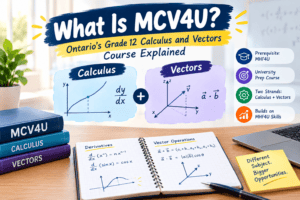
Courses like Advanced Functions and Calculus and Vectors build on each other week to week, with little time built in for review. A concept from October quietly resurfaces in a January problem set, and if it never fully clicked the first time, your teen is now stuck on two problems at once without realizing it. If your teen is choosing between courses like these, our breakdown of Data Management vs Calculus explains how different these paths actually are.
The Methods Look Different Than They Did in Your Day
Even topics you technically remember are often taught using different methods and notation now, which means the “right” way to explain something to your teen may not match what their teacher showed them in class. This mismatch can confuse a student more than it helps, even when your answer is correct.
What Can You Actually Do When You Don’t Know the Math?
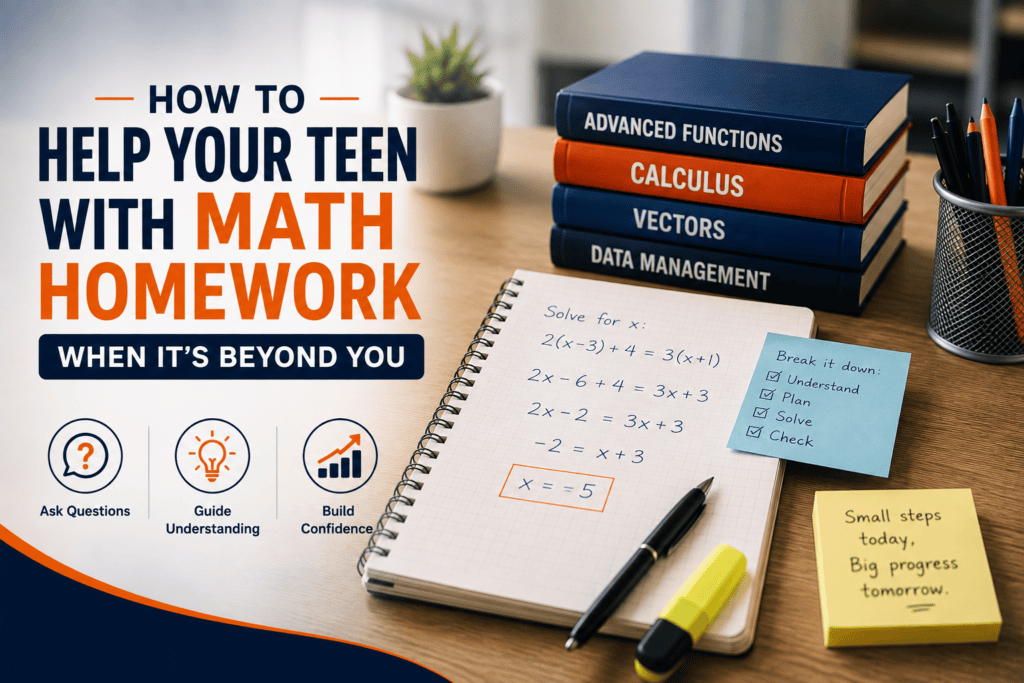
Your job isn’t to solve the problem. It’s to help your teen find their own way back into it, and that doesn’t require knowing the material yourself.
Ask Them to Explain It to You
Asking your teen to walk you through what they’ve tried so far often reveals exactly where their thinking breaks down, even if you can’t spot the actual math error. The act of explaining it out loud frequently helps a student catch their own mistake before you even need to say anything.
Ask What Looked Like This in Class Today
Homework problems almost always mirror something covered in class that same day or week. Asking “what did your teacher show you that looks like this?” pushes your teen back toward their own notes and examples, rather than treating you as the answer key.
How Long Should You Let Them Struggle Before Stepping Back?
Productive struggle genuinely helps learning, but past a certain point it stops teaching anything and just becomes frustrating for everyone involved.
The 20-Minute Rule
If a single problem has eaten twenty minutes with no real progress, it’s time to stop rather than keep pushing. Beyond that point, both of you are more likely to end up frustrated than to actually solve anything productive.
Why Pushing Past It Hurts More Than It Helps?
Continuing to grind on a problem neither of you can solve tends to reinforce the exact anxiety you’re trying to avoid, teaching your teen that math homework equals stress rather than something they can eventually work through.
What Are the Warning Signs It’s a Gap, Not Just a Hard Question?
One hard question here and there is completely normal. These specific signals mean something from earlier didn’t fully stick.
“I Understood It in Class but I Can’t Do It Alone”
This exact phrase is one of the clearest signals worth paying attention to. It usually means your teen followed the teacher’s example step by step but never built the flexibility to handle a slightly different version of the same problem on their own.
Passing Grades That Hide a Shaky Foundation
A passing grade doesn’t always mean real understanding, since partial credit can mask a shaky foundation for months before it catches up all at once on a bigger test. If you’re ever unsure whether outside support is actually worth it, our guide on how to know if a tutor is actually good explains exactly what real progress should look like.
How Do You Help Without Damaging Your Relationship?
Homework fights cost more than a single bad grade does, and most parents feel this tension without ever quite saying it out loud.
Separating “Parent” From “Math Teacher”
Trying to be both your teen’s parent and their math teacher in the same conversation rarely goes well, since frustration on either side gets tangled up with the relationship itself, not just the math. Recognizing when you’ve slipped into “teacher mode” and stepping back into “parent mode” instead often defuses tension faster than any explanation would.
When Is It Time to Get Outside Help?
There’s a specific point where more parental effort simply stops working, and recognizing it early can save an entire semester rather than just one rough night.
The Signals That Mean It’s Time
Repeated 20-minute standoffs, the “I understood it in class” pattern showing up often, or grades that don’t match how much time is being spent studying are all real signals worth acting on, not waiting out. At that point, more parental effort isn’t the missing piece anymore.
What Tutoring Actually Changes
A tutor can spend real, focused time finding exactly where understanding actually broke down, something a 9pm kitchen-table session rarely has room for. Whether that support happens through online vs in-person tutoring, the goal stays the same: catching the real gap before it compounds into something much bigger.
Final Thoughts
You don’t need to know calculus to help your teen through a hard math night. You need to know when to ask questions, when to step back, and when it’s genuinely time for outside support.
At TutorBoost, we specialize in finding exactly where understanding broke down, then rebuilding from there. Explore our service page to see how our tutoring works.
Frequently Asked Questions
Should I just tell my teen the answer if I know it?
Occasionally, but try asking a guiding question first. Simply supplying the answer skips the exact thinking process your teen needs to practice for the test.
Is it bad that I can’t help with my teen’s math homework?
Not at all. High school math genuinely moves beyond what most adults use day to day, and that’s a completely normal, common experience.
How do I know if my teen needs a tutor or just more practice?
If the same type of mistake keeps repeating despite consistent practice, that usually points to a real gap rather than something more practice alone will fix.
What if my teen refuses help from me?
This is common, especially with teenagers, and it’s often less about the math itself and more about not wanting a parent in a teaching role. A tutor can remove that tension entirely.
Can tutoring help if my teen is already passing?
Yes. Passing grades don’t always reflect a solid foundation, and addressing small gaps early tends to prevent much bigger struggles later in the course.