Organic Chemistry can feel like an endless collection of reagents, products, mechanisms, and exceptions. But trying to memorize every reaction separately is usually what makes the subject feel harder than it needs to be.
A better way to study Organic Chemistry is to understand why reactions happen. Learn how electrons move, recognize nucleophiles and electrophiles, group reactions into common patterns, and practise predicting products. You will still need to memorize some facts, but far fewer than you might think.
At TutorBoost, we encourage students to build understanding before relying on memorization. That approach matters especially in Organic Chemistry, where a small change in the reactant, reagent, or reaction conditions can turn a familiar-looking question into something completely different.
Do You Really Need to Memorize Every Organic Chemistry Reaction?
No. You need a combination of memorization, understanding, and practice. Trying to treat hundreds of Organic Chemistry reactions like vocabulary creates disconnected facts. Instead, decide what kind of learning each topic requires.
What Should You Memorize?
It helps to memorize common functional groups, important reagents, basic pKa trends, reaction conditions, terminology, and major exceptions.
You should be able to recognize an alcohol, alkene, carbonyl compound, carboxylic acid, amine, or alkyl halide without having to reason it out every time.
What Should You Understand?
Spend more time understanding electron flow, resonance, formal charge, acid-base behaviour, carbocation stability, nucleophiles, electrophiles, and leaving groups.
These concepts explain why bonds form and break. Once that logic is clear, many reactions stop looking like unrelated equations.
If chemistry concepts in general seem disconnected, our guide on why chemistry feels difficult explains why strong foundations matter before advanced topics begin to make sense.
How Can You Learn Reaction Mechanisms Instead of Memorizing Products?
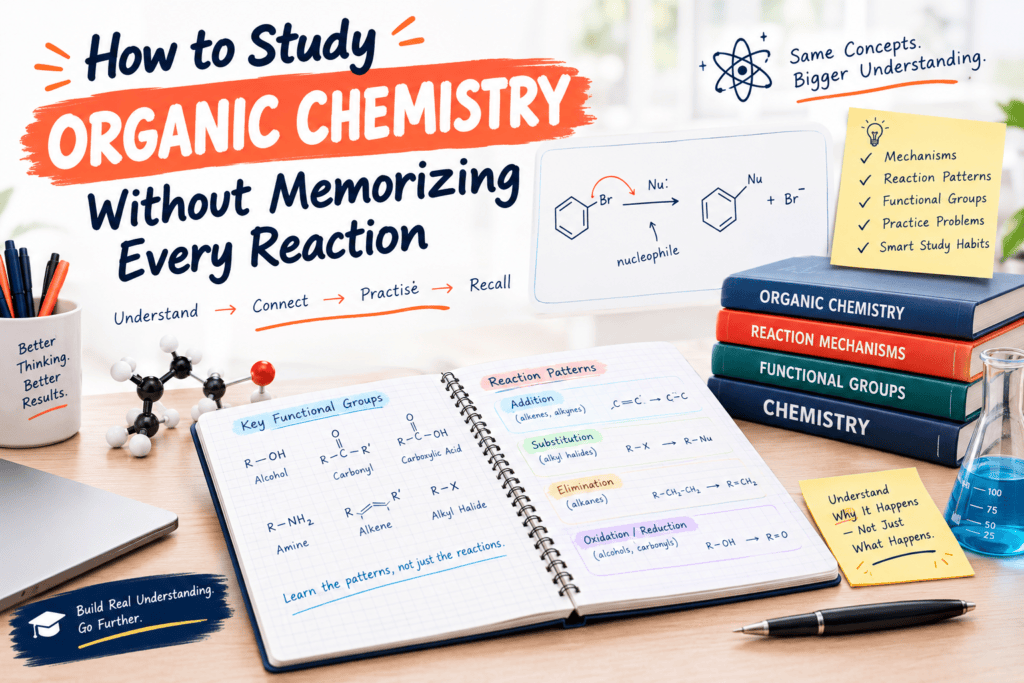
A reaction mechanism tells the story behind a chemical reaction. Instead of remembering only “reactant + reagent = product,” ask what the electrons are actually doing.
Curved arrows are especially important because they show electron movement. The arrow should begin where the electrons are and point toward where those electrons are going.
When looking at a reaction, ask:
What is the functional group? Where is the electron-rich region? Where is the electron-poor region? Which species is the nucleophile or electrophile? Is there a good leaving group? Which bonds are likely to form or break?
Making these questions automatic improves reaction mechanism recognition and makes product prediction much easier.
How Can You Recognize Organic Chemistry Reaction Patterns?
Instead of learning each reaction independently, organize reactions into families. Substitution reactions usually involve one group replacing another. Elimination removes groups and forms a π bond.
Addition reactions add atoms or groups across a multiple bond. Oxidation and reduction change bonding patterns, while many carbonyl reactions involve a nucleophile attacking an electrophilic carbon. The exact reagent still matters, but understanding the reaction family gives you a starting point.
This is also why learning nucleophile-electrophile logic is more useful than memorizing a long page of finished products. When the substrate changes on an exam, you still have a reasoning process to follow.
How Can a Reaction Map Make Organic Chemistry Easier?
A reaction map turns isolated reactions into connected pathways. Place major functional groups on one page and connect them with arrows showing how one can be converted into another. Add the reagent or important conditions above each arrow. For example, instead of memorizing separate oxidation and reduction reactions, connect alcohols, aldehydes, ketones, and carboxylic acids visually.
Reaction maps are particularly useful for synthesis problems because you can work backward from the desired product and ask which functional-group transformation could produce it.
Try rebuilding your map from memory once a week. The goal is not to create the prettiest page; it is to see the relationships between reactions.
How Should You Practise Organic Chemistry So Reactions Actually Stick?
Reading mechanisms repeatedly can make them look familiar without making you capable of producing them yourself. A better method is active recall.
Can You Draw the Mechanism Without Your Notes?
Study a mechanism, close the book, and redraw it from a blank page. Then compare your work with the correct answer.
Pay particular attention to incorrect curved arrows, missing intermediates, formal charges, stereochemistry, and the reason one pathway is preferred over another.
Should You Use Organic Chemistry Flashcards?
Yes, but use them selectively. Flashcards work well for functional groups, reagents, conditions, pKa trends, and facts that genuinely require recall. For complete reaction mechanisms, drawing and solving problems is usually more useful than simply flipping a card.
A good flashcard should also test reasoning. Instead of asking only what PCC does, ask what happens when PCC reacts with a primary alcohol and why the oxidation stops at that stage.
How Do You Approach an Organic Reaction You Have Never Seen Before?
This is where understanding becomes more valuable than memorization. First, identify the functional groups in the starting material. Next, locate electron-rich and electron-poor sites and determine what role the reagent is likely to play.
Then consider the leaving group, possible intermediates, resonance, steric effects, and relative stability. Predict which bonds should form or break before drawing the final product. If necessary, check regiochemistry and stereochemistry last.
You may not immediately know the exact answer, but this process gives you something far more useful than guessing from a memorized reaction list.
How Can You Study Organic Chemistry Every Day Without Cramming?
Consistency matters more than one huge study session. A simple 30-minute routine can include a short review of functional groups and reagents, followed by drawing mechanisms from memory, solving several mixed practice problems, and reviewing mistakes.
Keep an error log for questions you miss. Write down what you answered, the correct reasoning, and the concept you overlooked.
Over time, your mistakes reveal whether the real problem is resonance, acid-base chemistry, reaction conditions, stereochemistry, substitution and elimination, or another foundational concept.
What If You Understand the Notes but Still Cannot Solve Problems?
This often happens when a reaction looks familiar while your notes are open, but you cannot reproduce the reasoning independently.
Stop reading and attempt more problems without looking at the solution. When you get stuck, identify the exact step where your reasoning breaks down.
If the same gaps keep appearing, personalized Organic Chemistry tutoring can help you work through them directly. Rather than giving you another reaction list, a TutorBoost tutor can work through mechanisms and practice questions with you and focus on the concepts causing the difficulty.
What Is the Best Way to Study Organic Chemistry Overall?
Think of Organic Chemistry as a four-part process: understand, connect, practise, and recall. Understand electron movement and chemical behaviour. Connect reactions through mechanism families and reaction maps.
Practise product prediction and mechanisms without notes. Use active recall for the facts that truly need memorization. The goal is not to memorize nothing. It is to stop memorizing what you can learn to predict.
FAQs
Is Organic Chemistry mostly memorization?
No. Some facts and reagents require memorization, but reaction mechanisms become much easier when you understand electron flow, stability, and recurring reaction patterns.
What is the best way to remember Organic Chemistry reactions?
Group reactions by mechanism and functional-group transformations, build a reaction map, and repeatedly retrieve reactions from memory through practice problems.
How do I get better at Organic Chemistry mechanisms?
Practise identifying nucleophiles, electrophiles, leaving groups, intermediates, and electron movement before worrying about the final product.
Are flashcards useful for Organic Chemistry?
Yes. Use them mainly for reagents, functional groups, conditions, pKa trends, and exceptions rather than as a replacement for mechanism practice.
How often should I practise Organic Chemistry?
Short, consistent practice is usually more manageable than cramming. Work through mechanisms and mixed problems regularly so earlier reaction patterns stay fresh.