
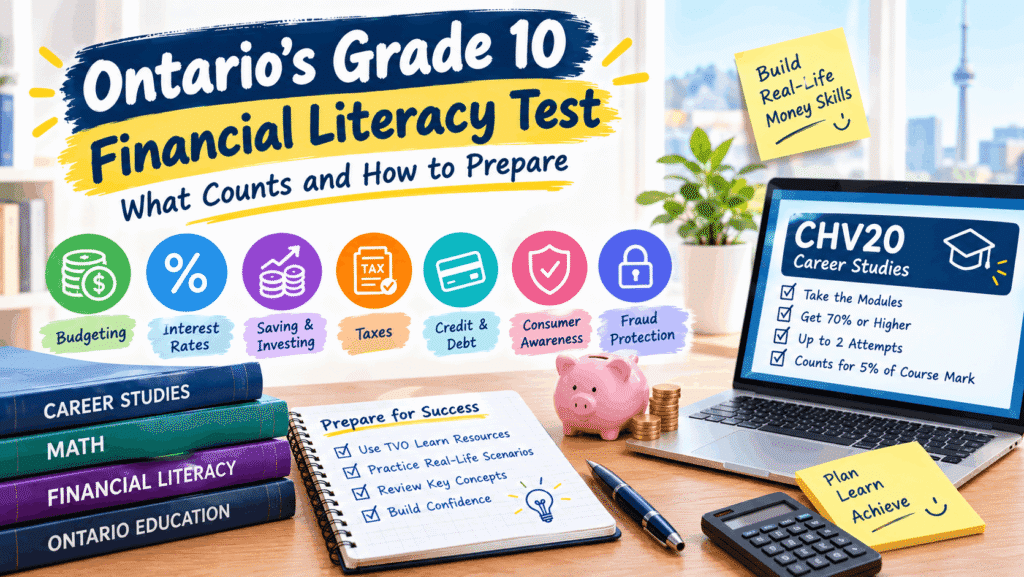
Does your teen have to pass a test to graduate? For many Ontario students, yes. The Grade 10 financial literacy test is now a graduation requirement, completed inside Career Studies.
Students need at least 70% within two attempts, and the result counts for 5% of the course mark. At TutorBoost, we tutor Career Studies and financial literacy, so here is a clear guide for parents and students.
Like the literacy test in our guide to what the OSSLT is, this is a diploma requirement, not an optional extra.
What Is Ontario’s Grade 10 Financial Literacy Test?
It is officially the Financial Literacy Graduation Requirement, a set of learning modules and test questions developed by TVO that schools give students during Grade 10 Career Studies (GLC2O). Parents often call it a test or exam, but Ontario’s Ministry of Education uses the official name.
Is It Part of Math or Career Studies?
Career Studies. Earlier plans placed it in Grade 10 math, but CBC News reported that Ontario kept it in Career Studies, so pages that still say “math course” are out of date.
Why Is Ontario Requiring a Financial Literacy Test?
The province says students need practical skills to manage their finances and make informed decisions. Education Minister Paul Calandra has pointed to real-world skills such as managing money and budgets.
Who Has to Complete It, and Who Is Exempt?
The requirement applies to students who began Grade 9 in 2025–26 or later, starting in the 2026–27 school year. Most will complete it in Grade 10 Career Studies this year.
Students who took Career Studies before 2026–27 do not have to complete it. The same is true for students who took a locally developed Grade 9 math course instead of MTH1W before September 2027, though from September 2028 all students must complete it.
What If Career Studies Is Online?
Unless the course includes secure online proctoring, students must attend in person on the day the modules are given, at their home school or another school their board names.
What Does the Financial Literacy Test Cover?
TVO Learn says it evaluates concepts such as budgeting, interest rates, earning and saving, taxes, credit and debt, consumer awareness and financial fraud. The Ministry says it assesses core concepts from the Grades 1 to 9 curriculum.
Why Do Grades 1 to 9 Matter?
Financial literacy is mandatory learning in Grades 1 to 8 math, the Grade 9 math course and Grade 10 Career Studies, so earlier gaps can show up here. Our Grade 9 math tutoring covers MTH1W, and Grade 9 is also home to the EQAO math assessment.
How Do the 70% Mark and Two Attempts Work?
Students need at least 70% on the modules and get up to two attempts during Career Studies. Once they meet the requirement, it is recorded on their Ontario Student Transcript.
The result counts for 5% of the final Career Studies grade, and the highest attempt is the one used. If a student has already met the requirement or is exempt, the 5% is left out of the course mark.
What Happens If Your Teen Doesn’t Pass?
The school guides families through each step. In the first week of Career Studies, it tells you when your teen will attempt the requirement, and you receive results and next steps within 5 days of each attempt.
What Happens After the First Attempt?
You receive the result and the date of the second attempt. Before it, your teen gets chances to build understanding, such as reviewing extra resources on TVO Learn and getting help at school.
What If the Second Attempt Doesn’t Pass?
The school recommends an option, and you choose one within 5 days. Options include a supervised retry outside the course, extra instruction, or TVO learning activities available from February 2027.
In extenuating circumstances, including when a student is close to graduation, an adjudication process is available. A student who fails Career Studies without meeting the requirement may repeat the course and gets two new attempts.
How Can Students Prepare for the Financial Literacy Test?
Start with the official resources, then practice the topics in real life. TVO Learn lists learning modules and practice assessments for the requirement.
At home, try the activities Ontario suggests: design a budget, compare loans, credit and investment options, weigh the pros and cons of different bank accounts and credit cards, and learn how to protect yourself from fraud. If interest rates or budget numbers feel shaky, review the number sense behind them.
Can Tutoring Help With Financial Literacy?
Yes, if your teen needs a calm walk-through of the topics or a stronger Grades 1 to 9 foundation. Our online tutoring services list Career Studies, financial literacy, money management and consumer awareness, with 1-on-1 sessions.
Frequently Asked Questions
Is there a financial literacy test in Grade 10 in Ontario?
Yes. It is completed within Grade 10 Career Studies for students who began Grade 9 in 2025–26 or later.
What mark do you need on the Ontario financial literacy test?
At least 70%, with up to two attempts during the course.
Is the financial literacy test part of math or Career Studies?
Career Studies. It assesses concepts from Grades 1 to 9, but it sits inside Grade 10 Career Studies.
Does the financial literacy test count toward your Career Studies mark?
Yes. It counts for 5% of the final mark, using your highest attempt.
What happens if you fail the financial literacy test?
You get a second attempt, then options such as supervised retries or extra support until you meet it.
Final Thoughts
Ontario’s financial literacy test is a chance to build money skills, and the steps are clear. If your teen needs support with Career Studies or Grades 1 to 9 math foundations, you can book a free trial session with TutorBoost.