Parents often imagine robotics class as tangled wires and confusing lines of code, something only “tech kids” can handle. The reality looks nothing like that. The first lesson usually starts with something far simpler: snapping pieces together and watching them move for the first time.
At TutorBoost, we get asked constantly what robotics actually involves, so here’s exactly what students learn, in the order they actually learn it.
What’s the First Thing You Actually Build in Robotics Class?
Robotics starts hands-on, with physical construction happening before anything technical enters the picture at all. This surprises a lot of parents who expect coding to come first.
Mechanical Design: Gears, Motors & Structure
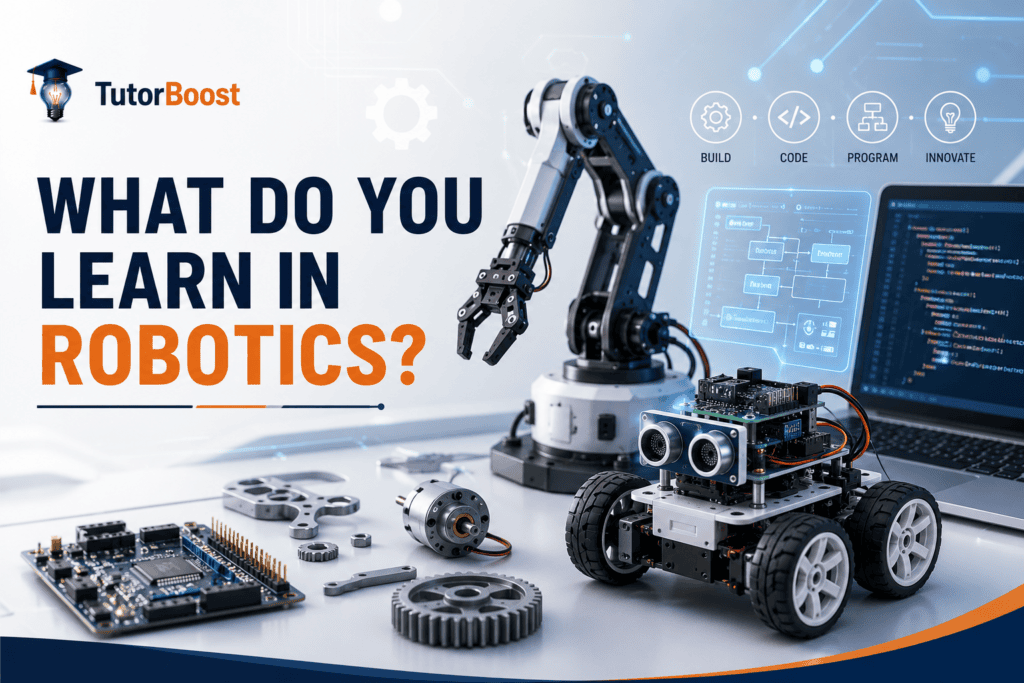
Students begin by working with gears, motors, wheels, and structural pieces, learning how these parts fit together to create something that can actually move.
Understanding why a smaller gear spins faster than a larger one, or how wheel placement affects balance, happens through direct hands-on trial rather than a lecture. This stage is closer to solving a physical puzzle than doing “tech work,” and it’s usually the part kids enjoy most immediately.
Why Building Comes Before Programming?
Building first matters because a robot’s physical design directly affects how well any code written for it will actually work. A wobbly structure or poorly placed motor makes even perfect code fail, since the robot simply can’t execute what it’s being told to do.
A good instructor catches these structural issues early rather than letting a student get frustrated with “broken code” that was actually a building problem all along, which is exactly the kind of attentiveness worth checking for when evaluating whether a tutor is actually good.
Students learn early that construction and programming depend on each other rather than existing separately, which is a lesson that shapes how they approach every project afterward.
How Do You Learn to Actually Code a Robot?
Coding is introduced gradually, carefully matched to a student’s age and prior experience rather than thrown at everyone the same way. At its core, every robot follows automation, a set of instructions it executes on its own once programmed, and learning to write those instructions is the heart of this stage.
Whether this happens in a physical classroom or through online vs in-person tutoring, the same core programming logic applies either way.
Beginners Start With Block-Based Coding
Younger or newer students typically start with block-based coding platforms like Scratch, where commands are dragged and snapped together like puzzle pieces instead of typed out. This removes the intimidation of syntax errors while still teaching real programming logic, like sequencing, loops, and conditional decisions.
A student building a line-following robot, for example, learns to chain together “move forward,” “check sensor,” and “turn” blocks, which is genuine programming logic even without a single line of typed code.
More Advanced Students Move to Real Programming Languages
As students progress, many transition to text-based languages like Python, which is commonly used for controlling more advanced robot behavior. The underlying logic they learned with blocks carries over directly, just expressed with typed syntax instead of drag-and-drop pieces.
What’s actually being built here is computational thinking, the ability to break a big problem into small, logical steps, and that skill transfers directly into math and science coursework. This progression means a complete beginner and a more experienced student can genuinely start at the exact same table, without either one being lost or bored.
How Does a Robot “Know” What’s Happening Around It?
Sensors and actuators are what allow a robot to actually respond to the world around it, rather than just following a fixed script blindly.
What Sensors Actually Do?
Sensors act as a robot’s eyes and ears, detecting things like light, distance, color, or touch, and feeding that information back into the robot’s code. A simple example is an infrared sensor that lets a robot follow a line drawn on the floor, adjusting its path in real time as it detects the line’s edges.
Ultrasonic sensors work similarly for distance, letting a robot detect a wall or obstacle before it collides with it.
How Actuators Turn Code Into Movement?
Actuators are the components that translate code into actual physical motion, like a motor spinning a wheel or an arm extending forward. Once a sensor detects something, like an obstacle ahead, it’s the actuator that carries out the robot’s response, whether that’s stopping, turning, or reversing direction.
Once students understand that sensors gather information and actuators act on it, the entire concept of “how a robot thinks” becomes far less mysterious.
How Does Robotics Connect to Subjects You Already Know?
Robotics isn’t a completely separate subject floating on its own, it directly reinforces math and science concepts students are already studying in school.
The Math Behind Motors, Gears & Movement
Calculating how far a robot travels per wheel rotation, or how gear ratios affect speed and torque, draws directly on algebra students already use in math class. A student adjusting gear ratios to make a robot climb a ramp is essentially solving a real algebra problem, just with a physical result instead of a worksheet answer.
This connection tends to reassure parents worried their child might be “behind” before even starting, since the math involved builds on familiar ground rather than introducing something entirely foreign.
The Physics of Balance, Force & Motion
Concepts like balance, friction, and force come up constantly once a robot needs to move without tipping over or losing traction. A robot that keeps tipping over on turns is running into the exact same center-of-gravity principles covered in a physics class, just made visible and immediate.
Older students often start exploring kinematics, the study of motion itself, as they calculate exact speeds and angles for more complex robot movements. Rather than learning physics from a textbook diagram, students see these same principles play out physically in front of them, which tends to make the concepts stick far more effectively.
What Do You Really Walk Away With Beyond Building and Coding?
Robotics classes consistently emphasize skills that extend well past the robot itself, often becoming just as valuable as the technical content.
Problem-Solving Through Trial and Error
When a robot doesn’t work as expected, and it frequently doesn’t at first, students learn to methodically test, adjust, and retest rather than giving up or guessing randomly. This kind of structured troubleshooting is a skill that transfers directly to schoolwork and everyday problem-solving far beyond robotics itself.
Teamwork & Communication in Group Projects
Most robotics classes involve small group projects, requiring students to divide tasks, explain their reasoning to teammates, and combine different ideas into one working design. These collaborative moments often end up being just as formative as anything technical the student learns.
Final Thoughts
Robotics class starts with building, moves into programming, and gradually connects to math and physics students already know, all while building problem-solving and teamwork skills along the way.
At TutorBoost, we help students strengthen exactly the math and science foundations that make robotics click faster. Curious about our approach? Check out our about us page. Ready to get started? Contact us or make an appointment today.
Frequently Asked Questions
Do you need coding experience before starting robotics?
No. Most robotics classes start with block-based coding designed specifically for complete beginners, so prior programming experience isn’t necessary.
What age is best to start learning robotics?
Many programs welcome students as young as six or seven using simplified tools, though the concepts scale naturally up through high school with more advanced programming and mechanics.
Is robotics more about coding or building?
It’s genuinely both. Most classes start with physical building before introducing programming, since the two skills reinforce each other throughout the entire process.
Do you need to be good at math to learn robotics?
Not going in, no. Robotics naturally reinforces math skills like basic algebra and geometry as students go, rather than requiring mastery beforehand.
How long does it take to build your first working robot?
Simple robots can often be built and made to move within a single class session, though more complex builds with sensors and custom programming typically take several sessions to complete.