
Every sound you hear is traveling to your ear as a wave. Sound waves are invisible yet everywhere in music, voices, traffic, and the ocean.
Understanding sound waves explains why you hear your favorite songs and how doctors use ultrasound. A sound wave is a mechanical disturbance that propagates through a medium, carrying energy as vibrations.
How Is a Sound Wave Defined?
A sound wave is the pattern of disturbance created when energy travels through a medium like air, water, or solids. It’s produced by vibrating objects pushing and pulling on the medium around them.
What Happens When Sound Is Created?
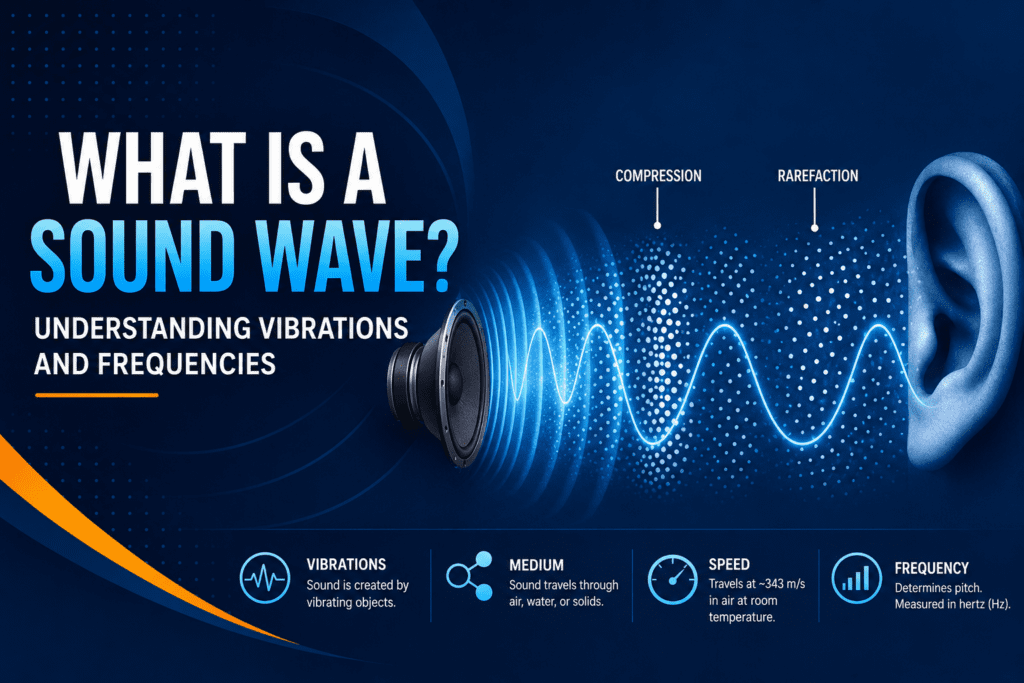
When a drum is struck, the drumhead vibrates outward and inward. As it moves outward, it pushes against air molecules, creating compressed air. As it moves inward, it creates regions where air molecules spread apart.
This back-and-forth motion compression followed by rarefaction repeats continuously, spreading outward from the source.
How Does Sound Travel?
Sound waves carry energy from the vibrating object to your ear, allowing you to hear. The vibrating object is the source. The medium (air, water, solids) is what the disturbance travels through. Unlike light, sound waves require a material medium, they cannot travel through the vacuum of space.
The mechanical disturbance spreads outward in all directions from the source, becoming less intense with distance. This is why conversations sound louder nearby and quieter far away. The wave carries energy, but that energy dissipates as it travels.
How Do Sound Waves Form and Travel?
Sound waves form when vibrations create pressure changes in the surrounding medium. The process is straightforward but fascinating.
The Compression and Rarefaction Process
When a tuning fork vibrates, one prong moves forward, compressing air molecules. This creates a compression, a region of higher-than-normal pressure. The prong then moves backward, creating a rarefaction, a region of lower pressure where molecules spread apart.
These compressions and rarefactions don’t stay in place. Compressed air molecules collide with neighboring molecules, transferring their energy. This chain reaction spreads outward as a wave, carrying the disturbance away from the source.
How Speed Works in Sound Waves
The wave travels through the medium at a constant speed (for a given medium and temperature). In air at room temperature, sound travels at approximately 343 meters per second.
This speed varies depending on the medium. If you’ve felt vibrations travel through a wooden floor, you’ve experienced sound traveling through a solid.
If physics feels weird and confusing sometimes, understanding how sound waves form clarifies wave behavior. Sound waves make waves concrete, you can understand them through everyday experience.
What Type of Wave Is a Sound Wave?
Sound is a longitudinal wave, meaning particles vibrate parallel to the direction the wave travels. This distinction is crucial for understanding how sound behaves.
Longitudinal Waves Explained
In a longitudinal wave, the medium’s particles move back-and-forth in the same direction the wave propagates. Imagine a slinky being pushed and pulled along its length. The coils move along the slinky’s direction, just as air molecules move along the sound wave’s direction.
Why Wave Type Matters?
By contrast, transverse waves (like light or ocean waves) have particles vibrating perpendicular to wave direction. This fundamental difference explains why sound and light behave so differently.
Sound’s longitudinal nature means it appears as compressions and rarefactions, not crests and troughs. One complete compression and one complete rarefaction together form one wavelength.
Because sound is longitudinal, it requires a material medium where particles can move back-and-forth.
In a vacuum, no particles exist to push and pull, so sound cannot propagate. Longitudinal waves also bend around obstacles, which is why you can hear around corners.
How Fast Do Sound Waves Travel?
Sound travels at different speeds depending on the medium it passes through. Speed varies dramatically fastest in solids, slowest in gases.
Speed in Different Mediums
In air at room temperature, sound travels at approximately 343 meters per second (1,235 km/h). In water, sound travels much faster approximately 1,480 meters per second. Water molecules are packed closer together, allowing sound to transmit more efficiently.
In steel or other solids, sound travels fastest approximately 5,000+ meters per second. The tightly packed particles enable rapid energy transfer.
Practical Speed Examples
You can hear a train approaching faster by placing your ear on the railroad track than by listening through air. Underwater creatures communicate across vast distances because sound travels far more efficiently in water than in air.
Temperature also affects sound speed. Warmer air increases molecular movement, allowing sound to travel slightly faster. Colder air slows sound.
During a lightning storm, you see the flash instantly but hear thunder seconds later. The delay tells you distance roughly one second equals 343 meters of distance.
What Are the Key Properties of Sound Waves?
Sound waves are characterized by four main properties: frequency, amplitude, wavelength, and speed. These properties determine how we perceive sound.
Frequency and Pitch
Frequency measures how many vibration cycles occur per second, expressed in hertz (Hz). One hertz equals one complete cycle per second.
Frequency directly determines pitch—what we hear as high or low. Middle C on a piano is 261.63 Hz. The A note above it is 440 Hz.
Humans with normal hearing detect frequencies between 20 Hz (very low bass) and 20,000 Hz (very high notes). Frequencies below 20 Hz (infrasound) and above 20,000 Hz (ultrasound) exist but humans cannot hear them.
Amplitude and Loudness
Amplitude measures how far particles move from their resting position during vibration. Larger amplitude means louder sound. Amplitude is measured in decibels (dB), a logarithmic scale. A whisper measures about 30 dB; normal conversation is 60 dB; a rock concert exceeds 100 dB.
Wavelength and Diffraction
Wavelength is the physical distance between consecutive compressions or consecutive rarefactions. Wavelength is inversely related to frequency higher frequency means shorter wavelength.
This relationship explains why low-frequency bass sounds diffract around walls while high-frequency treble doesn’t.
How Do We Actually Hear Sound Waves?
Sound waves reach our ears through air and cause the eardrum to vibrate. This vibration triggers a remarkable chain of events leading to hearing.
The Hearing Pathway
Compressions and rarefactions travel down the ear canal and strike the eardrum (tympanum). These pressure variations cause the eardrum to vibrate synchronously with the sound wave. The eardrum’s vibrations are transmitted to three tiny bones in the middle ear the hammer, anvil, and stirrup.
These bones amplify vibrations and transmit them to the inner ear’s cochlea, which contains fluid and hair cells. Hair cells respond to vibrations by converting mechanical motion into electrical signals sent to the auditory nerve. The brain interprets these signals as sound.
Why Some Frequencies Are Harder to Hear?
Human ears are not equally sensitive to all frequencies. We’re most sensitive to sounds between 300 Hz and 3,000 Hz—exactly where human speech primarily occurs.
Very low frequencies (below 50 Hz) and very high frequencies (above 10,000 Hz) require much higher amplitude to be perceived.
The ear’s maximum sensitivity occurs around 3,500 Hz due to natural resonance of the ear canal. This explains why a 100 dB bass note and a 100 dB treble note don’t sound equally loud.
Many students find learning about hearing mechanisms challenging, similar to how struggling with science is common when topics seem abstract. TutorBoost helps students understand the science and these mechanisms by connecting them to everyday experience.
What Are Practical Applications of Sound Waves?
Sound waves have countless real-world applications beyond just letting us hear.
Musical Instruments
Musical instruments create sound by vibrating at specific frequencies. String instruments produce sound when strings vibrate, creating different pitches based on string length and tension. Wind instruments vibrate columns of air. Percussion instruments vibrate at multiple frequencies.
Medical and Detection Applications
Ultrasound (above 20,000 Hz) is used in medical imaging to create pictures of organs and developing babies without radiation. Bats and dolphins use ultrasound echolocation, emitting high-frequency sounds and detecting echoes to navigate and hunt. Infrasound (below 20 Hz) is used in sonar systems to detect objects underwater.
These applications demonstrate that sound wave principles apply far beyond human hearing.
Why Can’t Sound Travel in Space Like Light Does?
Sound and light waves have fundamentally different natures. Sound is mechanical and longitudinal; light is electromagnetic and transverse. This difference explains everything about their behavior.
The Fundamental Difference
Sound waves are mechanical and longitudinal, requiring a material medium to propagate. Light waves are electromagnetic and transverse, traveling through the vacuum of space at 3 × 10⁸ m/s, nearly a million times faster than sound.
In space, no medium exists for sound to travel through, so sound waves cannot propagate beyond Earth’s atmosphere. The fundamental nature of each wave type creates these differences perfectly.
This explains why communication in space requires radio waves (electromagnetic, not mechanical). It also explains why we can see stars but cannot hear them, light reaches us across the vacuum, but sound never could.
What Exactly Is a Sound Wave?
A sound wave is a mechanical disturbance that propagates through a medium by transferring vibrational energy away from a source.
Sound is a longitudinal wave where particles vibrate parallel to the wave’s direction of travel, creating alternating compressions and rarefactions. The wave’s frequency determines pitch. Amplitude determines loudness.
Wavelength and speed depend on the medium. Understanding sound waves explains everything from music and speech to medical ultrasound, echolocation, and sonar. Sound waves are everywhere, constantly connecting us to the world around us.