
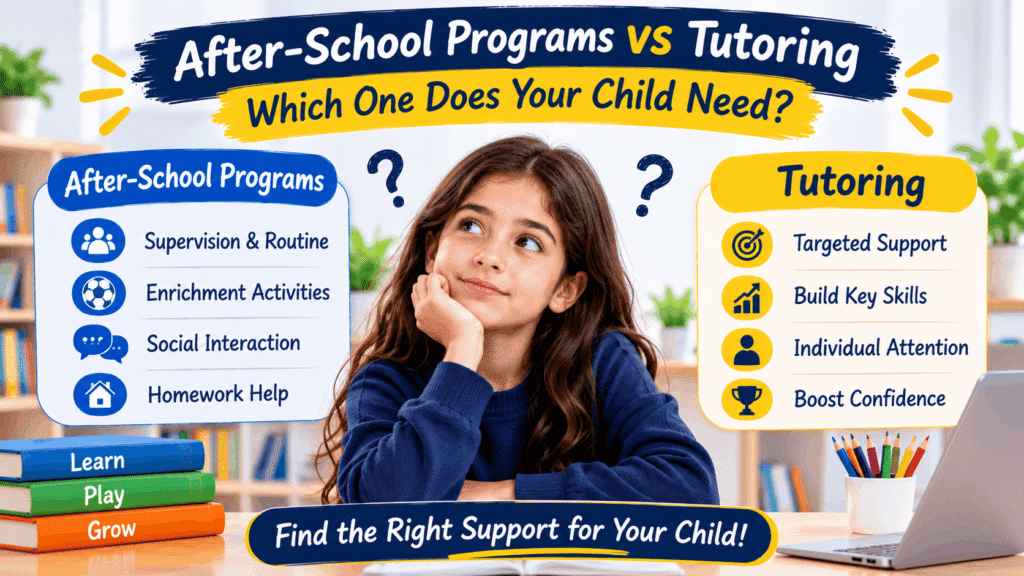
After-school programs and tutoring can both help children, but they solve different problems. An after-school program may be a better fit when your child needs supervision, routine, enrichment, social interaction, or general homework time. Tutoring makes more sense when a student has a specific academic gap, keeps struggling in one subject, or needs individualized instruction.
At TutorBoost, we work with families who often reach this exact decision point. The key is not choosing the option that sounds more academic. It is identifying what your child actually needs after school.
What Is the Main Difference Between an After-School Program and Tutoring?
An after-school program usually provides broader support. That may include supervised homework time, activities, enrichment, social interaction, and a structured routine after the school day ends.
Tutoring is more focused. It targets a particular subject, skill, or learning gap and gives the student direct instruction aimed at improving understanding and independence. That difference matters because finishing homework is not always the same as understanding it.
Is Homework Help the Same as Tutoring?
No. Homework help focuses mainly on getting the current assignment completed. Tutoring looks deeper and asks why the assignment is difficult in the first place.
If your child can finish the worksheet with help but still cannot solve a similar question alone the next day, the problem may require more than homework supervision.
What Does Your Child Actually Need Help With?
Before comparing programs, identify the problem you are trying to solve. Does your child mainly need somewhere structured to go after school? Do they need help staying organized and completing assignments? Or is one subject becoming increasingly difficult despite regular effort?
For children with a specific academic need, personalized online tutoring services can focus directly on the skill or subject causing difficulty rather than spending time on areas they already understand.
Does Your Child Need More Structure After School?
An after-school program may be the better fit when your child mainly needs a consistent routine, supervision, homework time, activities, or opportunities to interact with other children. That kind of environment can be valuable even when there is no major academic problem.
Is One Subject Consistently Falling Behind?
Tutoring becomes more relevant when the same subject keeps creating problems. For example, a child struggling with Math may not need more time doing worksheets. They may need someone to identify the earlier skill that is causing the current difficulty.
TutorBoost’s online Math tutoring for Ontario students is built around that kind of targeted support, from foundational Math through senior Ontario courses.
When Is an After-School Program the Better Choice?
After-school programs are usually better suited to broad support rather than one specific academic gap.
They can work well for children who benefit from a structured environment after school, especially when parents need reliable supervision or the child enjoys group activities.
Does Your Child Need Routine and Supervision?
If the main challenge is staying organized, completing homework on time, or having a predictable place to spend the afternoon, an after-school program may be enough. The child may not need intensive instruction. They may simply need structure.
Would Your Child Benefit From Social Interaction and Enrichment?
Many after-school programs include sports, arts, projects, clubs, games, or group activities. For children who need broader enrichment or more opportunities to interact with peers, that can be more useful than one-to-one tutoring.
When Is Tutoring the Better Choice?
Tutoring is usually the stronger option when the issue is academic and specific. The goal is not simply to keep the child busy after school. It is to identify where learning has broken down and help the student rebuild that skill.
Are Foundational Gaps Affecting New Learning?
Academic subjects often build on earlier knowledge. A student struggling with Grade 10 algebra, for example, may actually have an earlier weakness with equations or fractions. Unless that gap is addressed, new lessons can keep feeling harder.
Tutoring can work backward to fix the cause rather than repeatedly reviewing the latest assignment.
Does Your Child Need Individual Attention?
A group setting cannot always slow down for one student. One-to-one tutoring gives the tutor time to watch how the student approaches a problem, ask questions, change explanations, and check whether the student can complete the work independently.
If you want to understand what makes that kind of support effective, our guide on whether online tutoring really works explains what parents should look for.
How Is After-School Homework Help Different From 1-on-1 Tutoring?
The clearest difference is the goal.
After-school homework help often asks:
“How can we finish tonight’s work?”
One-to-one tutoring asks:
“Why is this work difficult, and which skill needs to improve?”
That difference becomes important when homework gets completed but test results, confidence, or independent problem-solving do not improve. If the same mistakes keep returning each week, general homework help may no longer be enough.
Is One-on-One Tutoring Better Than Group Support?
Neither format is automatically better for every child. Group support can work well for enrichment, peer interaction, general practice, and students who enjoy learning alongside others.
One-to-one tutoring is often more useful when the difficulty is specific, the student needs a different pace, or the tutor must repeatedly diagnose and correct individual mistakes. The choice should follow the learning need rather than the format alone.
Can a Child Benefit From Both Tutoring and an After-School Program?
Yes. A child might attend an after-school program for routine, supervision, activities, and homework time while meeting with a tutor once or twice a week for a specific academic gap.
The two services do not have to compete with each other because they can serve different purposes. The important question is whether each one is solving a real need.
How Can You Tell Which Option Your Child Needs?
Think about the main problem.
If your child needs routine, supervision, enrichment, social interaction, or general homework support, an after-school program may be the better starting point.
If your child needs subject-specific instruction, help closing a learning gap, individual explanations, or progress tracking, tutoring is more targeted. If both needs exist, a combination may make sense.
What Questions Should Parents Ask Before Choosing?
Start with one question:
What problem am I actually trying to solve?
Then consider whether your child needs help completing work or understanding it. If tutoring seems like the better fit, check the tutor’s subject experience, teaching style, progress tracking, and whether your child feels comfortable asking questions. Our questions to ask before hiring an online tutor can help you compare options more carefully.
What Signs Suggest Tutoring May Be the Better Next Step?
Tutoring may be worth considering when one subject keeps falling behind, homework requires constant explanation, the same mistakes continue, or classroom lessons are not clicking despite effort.
Another sign is when the student can complete work only with an adult beside them. The goal of tutoring should be greater independence over time, not permanent dependence on help.
How Does Online Tutoring Change the Comparison?
Online tutoring gives families another option between a traditional tutoring centre and a general after-school program. Students can receive targeted one-to-one support from home without adding another commute to the family schedule.
That can be especially useful when a child already has activities after school but still needs focused academic help in Math, Science, English, French, or another subject.
When Can TutorBoost Fit Into Your Child’s After-School Routine?
TutorBoost can fit best when your child already has a routine but needs targeted academic support within it.
A student may complete general homework independently but still need help understanding a difficult Math unit, improving writing, or rebuilding a foundational Science skill.
In that situation, tutoring can supplement the child’s existing routine rather than replace extracurricular activities, family time, or independent study.
What Is the Simplest Way to Choose?
Choose an after-school program when the main need is broad support. Choose tutoring when the main need is a specific learning gap.
If your child needs both structure and targeted academic instruction, you do not necessarily have to choose only one. The right option is the one that solves the problem your child is actually facing.
Frequently Asked Questions
Is tutoring better than an after-school program?
Not always. Tutoring is more targeted academically, while after-school programs often provide broader structure, enrichment, and supervision.
Is homework help the same as tutoring?
No. Homework help focuses on completing current work, while tutoring aims to improve the underlying skills that make the work difficult.
How do I know if my child needs a tutor?
Repeated difficulty in one subject, recurring mistakes, falling confidence, or needing constant help with the same skills can point to a tutoring need.
Can after-school programs help with homework?
Yes. Many provide homework time or general guidance, but that is different from individualized instruction focused on closing a learning gap.
Can my child do both tutoring and an after-school program?
Yes. An after-school program can provide routine and enrichment while tutoring targets a specific academic need.