Your chemistry class: salt is neutral, pH 7. Your teacher next week: salt hydrolysis exists, some salts are acidic or basic. Your brain: Wait… what?
That’s the confusion we see all the time when students start struggling with science concepts. You memorized that salt equals neutral. Now your teacher mentions hydrolysis and suddenly some salts are acidic? Some are basic? Both feel true, yet contradictory.
Here’s the truth: both are right. It depends entirely on the salt. Table salt? Neutral. Baking soda? Basic. Some fertilizer salts? Acidic. Let me show you why.
What Is Salt? (Quick Definition)
A salt is an ionic compound formed when an acid reacts with a base. When hydrochloric acid (HCl) meets sodium hydroxide (NaOH), they neutralize each other. The result: sodium chloride, table salt plus water.
That simple reaction is the foundation: Acid + Base = Salt + Water.
But here’s where it gets interesting. Not every acid is equally strong. Not every base is equally strong. And that difference? That’s what determines whether your salt ends up neutral, acidic, or basic.
Is Table Salt (NaCl) an Acid or Base?
Your table salt is neutral. It has a pH of 7, neither acidic nor basic.
This happens because table salt comes from a strong acid (HCl) and a strong base (NaOH). When strong meets strong, neutrality wins. That’s why your food tastes neither sour nor bitter. The salt contributes no extra hydrogen ions (which would make it acidic) or hydroxide ions (which would make it basic).
But other salts? Different story entirely.
But Wait… Some Salts Are ACIDIC or BASIC?
This is where salt chemistry gets interesting. Not all salts are neutral. Some salts are acidic, some are basic.
This happens because not all acids and bases are equally strong. When a weak acid combines with a strong base, the resulting salt can tip toward basic. When a strong acid combines with a weak base, the salt tips toward acidic. This process is called salt hydrolysis, and it’s simpler than your textbook makes it sound.
Salt hydrolysis means the ions of the salt interact with water molecules, affecting the pH. The weaker component in the reaction determines which way the salt leans.
The Simple Rule to Remember
Forget complex formulas. Remember this:
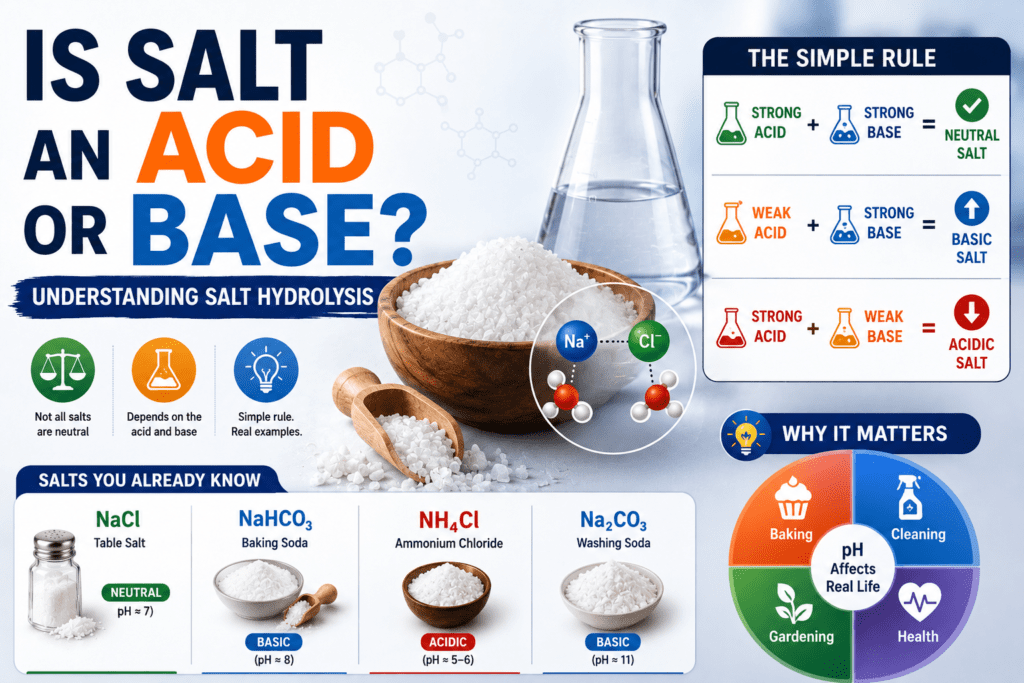
Strong acid + Strong base = NEUTRAL salt (Example: HCl + NaOH = NaCl, table salt)
Weak acid + Strong base = BASIC salt (Example: Acetic acid + NaOH = Sodium acetate)
Strong acid + Weak base = ACIDIC salt (Example: HCl + Ammonia = Ammonium chloride)
That’s it. Apply this framework to any salt, and you can predict its pH. You don’t need formulas. You don’t need to memorize Ka and Kb values. Just identify the strength of each acid and base involved, and the salt’s nature becomes obvious.
Real Examples: Salts You Already Know
Let’s stop talking about chemical formulas and talk about salts you already know. Understanding which salts are neutral, acidic, or basic explains real chemistry happening around you.
Table Salt (NaCl) – NEUTRAL
Your table salt is neutral (pH 7) because it comes from strong acid HCl and strong base NaOH. That’s why it tastes neither sour nor bitter, and why it’s perfect for seasoning any food.
Baking Soda (NaHCO₃) – BASIC
Baking soda is basic (pH ~8) because it comes from a weak acid and strong base. That’s why baking soda is used in baking, it reacts with acidic ingredients like buttermilk or lemon juice to create rising dough. It’s also why it neutralizes acidic odors in your refrigerator.
Ammonium Chloride (NH₄Cl) – ACIDIC
Ammonium chloride is acidic (pH ~5-6) because it comes from strong acid HCl and weak base ammonia. That’s why it’s used in fertilizers, some crops benefit from slightly acidic soil conditions. You’ll also find it in dry cell batteries.
Washing Soda (Na₂CO₃) – BASIC
Washing soda is strongly basic (pH ~11) because it comes from a very weak acid and strong base. That’s why it works so well for laundry, its basicity helps remove oils and stains better than neutral salt could. It also softens water by binding to minerals that make water “hard.”
Why Does This Matter?
Salt pH isn’t just academic. It affects real chemistry happening in your kitchen, laundry, and garden.
In Baking: Baking soda’s basicity reacts with acidic ingredients, creating the carbon dioxide bubbles that make your cake rise. Without the pH interaction, you’d have a dense, flat cake.
In Cleaning: Washing soda’s stronger basicity (compared to table salt’s neutrality) breaks down grease and dirt more effectively. That’s why it’s preferred for tough cleaning jobs.
In Gardening: The pH of salt compounds in soil affects plant growth. Fertilizer salts can make soil more acidic or basic, and plants respond differently to each. Some crops thrive in acidic soil, others in basic soil.
In Your Body: Even your body’s chemistry depends on salt pH. Different salts are used in medicine because their pH affects how your body processes them.
This understanding connects chemistry to your real world. And if you’re struggling with science at this deeper level, that’s normal acid-base chemistry ties together many concepts, and sometimes you need expert guidance to see how they fit.
Common Misconceptions About Salt
All salt is neutral
FALSE. Only salts from strong acid + strong base combinations are neutral. Baking soda proves this.
Salt means table salt only
FALSE. Salt is a whole category of ionic compounds. There are hundreds of different salts with different pH values.
Hydrolysis destroys salt
FALSE. Hydrolysis doesn’t break salt apart. It just means the ions interact with water, affecting pH. The salt still exists.
You need to memorize which salts are acidic or basic
FALSE. Use the simple rule: strong + strong = neutral, weak base + strong acid = acidic, weak acid + strong base = basic. You can predict any salt’s pH using this framework.
Final Thoughts
So, is salt an acid or base?
Table salt (NaCl)? Neutral. Other salts? It depends.
Remember the framework: strong acid + strong base = neutral salt. Weak acid + strong base = basic salt. Strong acid + weak base = acidic salt.
This understanding isn’t just for passing chemistry tests. It explains why baking soda works in recipes, why washing soda cleans better than regular salt, why fertilizers affect soil pH, and why different salts are used in medicine.
If this topic still feels confusing, or you want to master the full picture of acid-base chemistry, TutorBoost offers expert chemistry tutoring in your city. One-on-one tutoring breaks down exactly where you’re stuck, transforms confusion into clarity, and builds the foundation for everything that comes next.
You might also want to explore more about related acid-base concepts. We’ve written detailed guides on is NaOH an acid or base, is NH3 an acid or base, each covering specific salt examples and their properties in depth.
Frequently Asked Questions
Why is some salt acidic if acid + base = neutral?
Because not all acids and bases are equally strong. When the weak component in the reaction dominates, it determines the salt’s pH.
Is table salt safe to eat if it’s neutral?
Yes. Neutral pH (7) is safe. Your body actually needs salt for vital functions like nerve transmission and muscle contraction.
What is salt hydrolysis exactly?
When salt dissolves in water, its ions interact with water molecules. This interaction is hydrolysis, and it affects the pH of the solution.
Will this be on my chemistry exam?
Very likely. Salt pH and salt hydrolysis are standard topics in Grade 11-12 chemistry courses across Canada and most curricula.
How do I know if a salt is acidic or basic without looking it up?
Think about what acid and base created it, then determine their strengths. If one is weak, the salt leans that direction. Use the simple rule from the article above.