Parents can usually tell whether their child enjoyed a tutoring session, but rarely know whether it was actually well-structured or just pleasant conversation that felt productive. At TutorBoost, we’ve sat through enough sessions, good and mediocre, to know exactly what separates the two. Here’s what a genuinely effective session looks like, walked through with a real example.
What Actually Happens in the First Few Minutes?
A strong session doesn’t start with content. It starts with connection and a quick read on where the student actually stands that day, before a single new concept gets introduced.
Building Rapport Before Diving Into Material
Spending the first few minutes checking in, asking about their day, or referencing something from last session isn’t wasted time, it directly affects how open a student is to admitting confusion later on. Students who feel rushed straight into material are far less likely to speak up when something doesn’t make sense, which means small gaps quietly pile up instead of getting caught early.
A Quick Check-In on What’s Already Understood
Before teaching anything new, a good tutor asks the student to explain or attempt something related to the previous session’s material. This isn’t a formal quiz, it’s a quick gauge that reveals whether last week’s concept actually stuck, or whether today’s plan needs to shift to address a gap first.
Skipping this step is one of the most common reasons sessions feel productive in the moment but don’t actually move a student forward over several weeks.
Why Does a Session Need a Clear Objective?
Without a stated goal, a session can easily drift into generic homework help rather than real, targeted progress on a specific skill.
What a Clear Objective Actually Sounds Like?
A vague plan like “help with chemistry” leads nowhere specific. A clear objective sounds more like “understand how to calculate concentration using titration by the end of this session.” Stating this out loud at the start gives both the tutor and student a concrete target to measure the session against, rather than just filling an hour.
What Does a Real Chemistry Example Look Like in Practice?
Here’s exactly how this structure plays out with an actual concept, not an abstract description of “guided practice.”
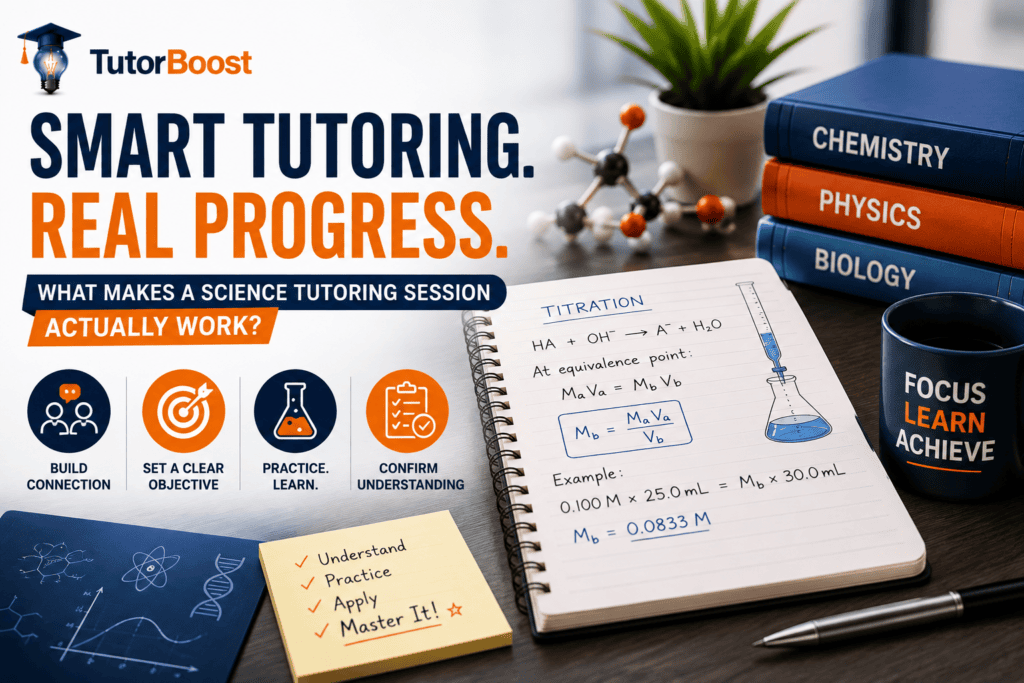
A Worked Example: Teaching Titration From Scratch
A student struggling with titration starts the session by attempting a basic concentration problem unprompted. They get the setup right but stumble at converting volume to moles.
Rather than immediately correcting the mistake, the tutor asks the student to walk through their reasoning out loud, which reveals the actual gap: they understand the concept of titration itself but haven’t fully connected it to the pH scale concept of concentration they learned weeks earlier.
The tutor bridges that connection directly, drawing the link between the two ideas explicitly rather than assuming the student would eventually make it on their own, then has the student retry the same problem type with a new variation to confirm the gap is actually closed.
Where the Student Gets It Wrong, and Why That’s Useful?
That first wrong attempt wasn’t a failure, it was the most useful five minutes of the entire session. Watching exactly where and how a student goes wrong reveals far more about the real gap than a student who guesses correctly without understanding why.
A tutor who skips this step and jumps straight to demonstrating the right answer misses the chance to find out what’s actually missing, and often ends up re-explaining the same gap again the following week without realizing it.
How Do You Know if Progress Actually Happened?
A good session ends with proof of understanding, not just a friendly goodbye and a vague sense that the hour went well.
A Real Wrap-Up Versus Just Running Out of Time
A strong close involves the student solving one final problem independently, with the tutor watching rather than guiding, to confirm the concept actually transferred.
A session that simply runs out the clock without this check leaves both the tutor and the parent genuinely unsure whether anything was retained, no matter how smoothly the hour felt in the moment.
This same attention to pacing and structure is exactly what separates productive study time from busy work, the same principle covered in our guide on time management for students.
How Can You Tell if Your Own Child’s Sessions Are Structured This Well?
This structure gives you a genuine, checkable list to evaluate what’s actually happening behind closed doors during your child’s own sessions.
Questions Worth Asking Your Child After Each Session
Ask what the goal of today’s session was, not just what they “worked on.” Ask what they got wrong and how they figured it out, not just what they got right.
Vague answers to these questions are often the clearest sign that a session lacked real structure, and it’s exactly the kind of gap worth addressing when evaluating whether a tutor is actually good at their job, not just personable during the hour.
Final Thoughts
A genuinely effective science tutoring session follows a real structure: connection first, a clear objective, room to make and learn from mistakes, and proof of understanding before it ends.
At TutorBoost, every session is built around exactly this structure, not just friendly conversation that happens to touch on schoolwork. Explore our service page to see how our sessions actually work.