
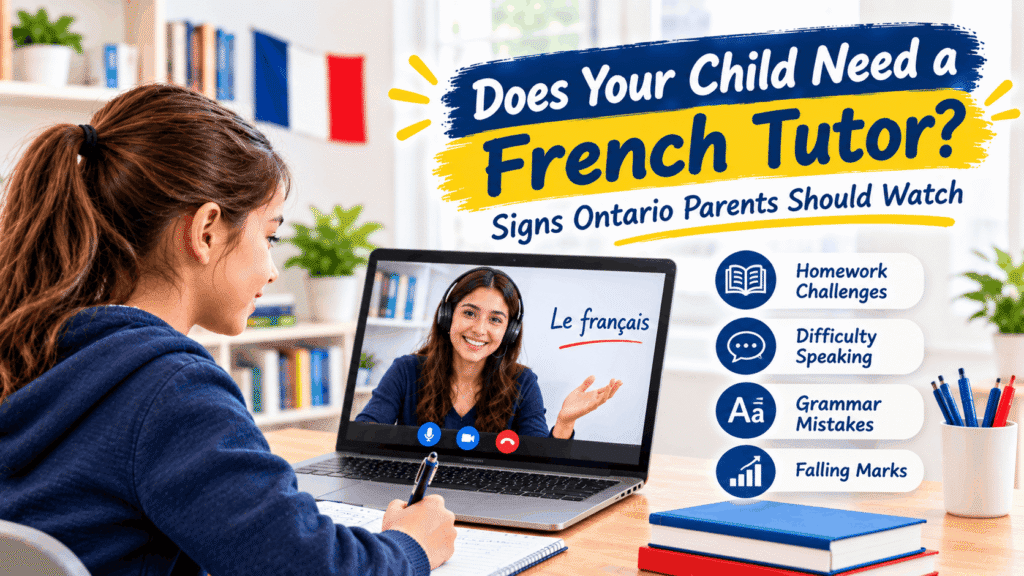
Your child may benefit from a French tutor if difficulty with reading, speaking, grammar, homework, or comprehension keeps repeating rather than appearing during one difficult lesson. Falling marks, avoiding French, repeated teacher feedback, or understanding a concept in English but not in French can also point to a learning gap that deserves attention.
In Ontario, French learning becomes especially important from Grades 4-8. At TutorBoost, students can get personalized support that focuses on the specific language skill causing difficulty rather than simply adding more worksheets.
For families who want targeted help, French tutoring can focus on speaking, listening, reading, writing, grammar, and the Ontario curriculum your child is already learning at school.
How Can You Tell Whether Your Child Is Actually Struggling With French?
One difficult quiz or confusing homework assignment does not automatically mean your child needs tutoring.
French is a second language for many Ontario students, so mistakes are part of learning. What matters is whether the same difficulty continues across several weeks and starts affecting homework, participation, confidence, or classroom performance. Look for patterns rather than one bad day.
What Signs May Show Your Child Needs a French Tutor?
The strongest warning signs usually appear in more than one part of learning. A student might struggle with written work, avoid speaking, and become increasingly frustrated with homework at the same time.
Does French Homework Take Much Longer Than Expected?
French homework should challenge students, but it should not regularly turn into a long period of guessing, frustration, or dependence on translation tools.
If your child understands the task only after someone explains every sentence in English, vocabulary or reading comprehension may be slowing them down.
Does Your Child Avoid Speaking French?
Some hesitation is normal, especially when pronunciation is new. The concern is when your child consistently avoids answering in French, gives the shortest possible responses, or becomes anxious about oral presentations and classroom participation.
A French tutor can provide a lower-pressure environment for practising oral communication and building speaking confidence.
Can Your Child Read French but Not Explain What It Means?
Pronouncing the words and understanding the message are different skills.
If your child can read a paragraph aloud but cannot explain the main idea, follow written instructions, or answer questions about it, the gap may be in vocabulary or reading comprehension rather than pronunciation.
Do the Same Grammar Mistakes Keep Returning?
Repeated difficulties with verb conjugation, gender agreement, sentence structure, or written expression can become more noticeable as students move into Grades 6–8.
The issue is not making mistakes. It is continuing to make the same mistakes after they have already been taught and corrected several times.
Are Marks and Teacher Comments Showing the Same Problem?
Grades should not be the only reason to consider tutoring, but repeated teacher feedback can reveal a pattern.
Comments about weak comprehension, limited oral participation, grammar, incomplete writing, or difficulty following French instructions are more useful when considered together.
Are French Struggles Different in Grades 4-5 and Grades 6-8?
Yes. French expectations develop as students gain more experience with the language, so parents should not expect a Grade 4 student and Grade 8 student to struggle in exactly the same way.
What Should Parents Watch for in Grades 4-5?
Earlier learners may need support with basic vocabulary, understanding spoken French, simple sentence construction, reading short passages, and becoming comfortable speaking.
Confidence matters heavily at this stage because students are still learning how to communicate without translating every thought from English first.
What Changes in Grades 6–8?
Older students generally face more demanding reading, writing, grammar, verb conjugation, paragraph development, listening comprehension, and oral presentations.
A gap that seemed small in Grade 5 can become more obvious when students are expected to work more independently in Grade 7 or 8.
Is Your Child Struggling With French or With the Subject Itself?
This distinction is especially important in French Immersion. A language gap means the child understands the underlying concept but struggles to access it in French. A broader academic gap means the concept itself is difficult regardless of the language.
For example, if your child can solve a Math problem when it is written in English but becomes confused by the same type of problem in French, reading comprehension may be the real barrier. If the problem is equally difficult in both languages, French may not be the main issue.
Does Core French Require Different Support From French Immersion?
Yes. The language is used differently in the two programs. In Core French, students primarily study French as a subject. Difficulties may show up most clearly in vocabulary, oral communication, grammar, reading, and writing.
In French Immersion, French is also used to learn other subjects. A language gap can therefore affect a student’s ability to understand instructions, read a Science passage, or explain an answer in another class. The tutor should understand which program your child is in before deciding what to work on.
What If You Do Not Speak French at Home?
You do not need to speak French fluently to recognize when your child is struggling. Pay attention to how long homework takes, whether your child avoids the subject, what the teacher repeatedly comments on, and whether confidence is changing.
You can also ask your child to explain in English what they were supposed to learn. If they cannot explain the concept at all, the difficulty may be broader than French vocabulary.
When Is More Practice Enough, and When Does Tutoring Make Sense?
A little extra practice may be enough when the difficulty is temporary, such as learning one new verb tense or studying unfamiliar vocabulary.
Tutoring makes more sense when the same gap keeps returning despite regular classroom instruction and practice.
A useful pattern to watch is:
difficulty → repeated mistakes → frustration → little independent improvement
Parents unsure whether online support is the right format can also see what makes online tutoring effective before deciding.
What Should a Good French Tutor Work On?
A French tutor should not automatically start with a generic lesson plan.The first priority is finding out whether your child needs help with listening comprehension, speaking, pronunciation, reading comprehension, vocabulary, grammar, verb conjugation, or writing.
The tutor should then connect that skill to the student’s current schoolwork and Ontario curriculum expectations.
If you are comparing tutors, the questions in Online Tutor Needed can help you check subject experience, teaching methods, progress tracking, and fit.
What Should Parents Expect From the First French Tutoring Session?
The first session should clarify the student’s grade, French program, current unit, teacher feedback, and strongest and weakest language skills.
The tutor may ask the student to read, answer simple questions, explain vocabulary, write a short response, or speak briefly in French. The goal is not to test everything at once. It is to identify where communication starts becoming difficult.
How Can You Tell Whether French Tutoring Is Working?
Progress may appear before the report-card grade changes.
Homework may take less time. Your child may become more willing to speak French, understand passages more independently, make fewer repeated grammar mistakes, or write with less assistance. Good French tutoring should gradually make your child less dependent on the tutor.
When Can French Tutoring Help Your Child Most?
French tutoring is most useful when it targets a recurring language gap rather than simply completing homework for the student.
One-to-one support can give children more time to speak, ask questions, practise difficult language skills, and receive immediate feedback without the pressure of an entire classroom.
The goal is stronger communication and independence—not perfect French after a few sessions.
Frequently Asked Questions
How do I know if my child needs a French tutor?
Look for repeated difficulty with homework, comprehension, speaking, grammar, or writing that continues despite regular classroom practice.
What age should a child start French tutoring?
There is no single best age. Extra support can help whenever a recurring gap begins affecting confidence, participation, or schoolwork.
Can a French tutor help with French Immersion?
Yes. A tutor can help separate language difficulties from subject difficulties and strengthen reading, speaking, listening, grammar, and writing.
What if I do not speak French but my child is in French Immersion?
You can still monitor homework time, frustration, teacher feedback, confidence, and whether your child understands the underlying concepts.
How often should a child have French tutoring?
It depends on the size of the gap and the student’s goals. Consistent sessions are usually more useful than irregular help only before tests.