
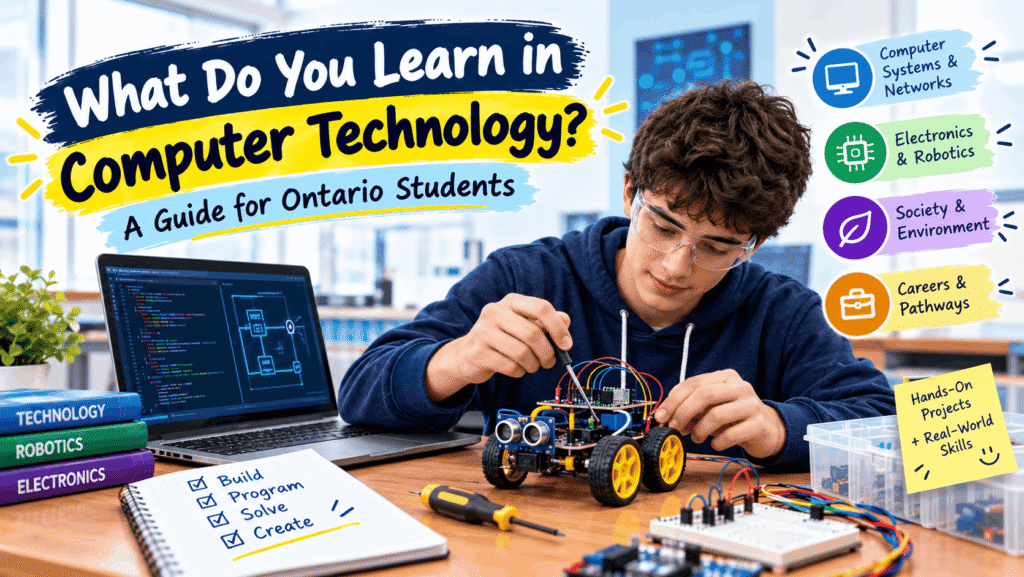
In Ontario’s Grade 10 computer technology course (TEJ2O), students learn how computers and networks work, build and test small circuits, and program simple devices or robots. There is no prerequisite, so any Grade 10 student can sign up.
If your teen is choosing electives, the course title alone does not say much. At TutorBoost, we help Ontario students make sense of their courses, so here is what actually happens in class, what comes after Grade 10, and how to prepare.
What Is Computer Technology as a High School Course?
Computer technology is an Ontario technological education course about how computer systems, networks and electronics work and are built. It focuses on hardware and hands-on building more than on writing software.
Who Can Take Grade 10 Computer Technology?
It is an Open course, which means students at any level can take it. No earlier course is required.
What Does the Course Code TEJ2O Mean?
The “2” stands for Grade 10 and the “O” stands for Open. Some schools list slightly different codes, such as TEJ201, so check your own school’s course calendar.
How Is Computer Technology Different From Computer Science?
Computer science courses, which start with ICS, focus on programming languages like Python or Java. Computer technology looks at the machines themselves and how programs control them. If coding is what your teen really wants, our post on why computer science feels impossible is a useful start.
What Do You Learn in Grade 10 Computer Technology?
The course covers four areas: computer systems, electronics and robotics, technology’s impact on society and the environment, and careers. School boards describe these the same way, though each school adds its own projects.
How Do Computers and Networks Work?
Students assemble, repair and configure computers, and they work with different operating systems and application software. They also learn how computers connect in networks.
Fundamentals like binary numbers and digital logic often appear here too. They lean on math thinking, so students who are shaky on number patterns may find our math tutoring helpful.
What Do You Learn About Electronics and Robotics?
Students build small electronic circuits and write programs that control simple devices, such as LEDs, motors and sensors. Reading circuit diagrams is a skill of its own, and one mistake that ruins circuit schematic diagrams shows what to watch for.
Robotics often gets its own units. Our guide on what you learn in robotics covers that side in more detail.
What Are the Environmental and Career Topics?
The course also looks at how technology affects society and the environment, plus safe work practices in a shop or lab. Students finish by exploring secondary and postsecondary pathways in computer technology.
What Do Students Actually Do in Class?
The course is hands-on, so most learning comes from building, testing and fixing things. Expect less lecturing and more time at a workbench or computer.
What Hands-On Projects Do Students Complete?
Projects vary by school. Some classes take devices apart to see how circuits and power flow work, test designs in a simulator, then build them on a breadboard. Others add 3D printing or laser cutting.
A few programs go further. At least one university-run version of the course adds an introduction to artificial intelligence and cybersecurity.
Do Students Learn to Code?
Yes, but at a simple level. Students write short programs to control a device or robot, often with block-based or beginner-friendly tools.
How Are Students Assessed?
Marks usually combine ongoing project work with a final task, such as a performance task and sometimes a written exam. Your school’s course outline will give the exact split.
What Comes After Grade 10 Computer Technology?
The path continues into computer engineering technology in Grades 11 and 12. Many schools recommend taking the courses in order.
What Does Grade 11 Cover?
Grade 11 computer engineering technology (TEJ3M) builds on the basics. Students assemble computers and small networks, and build systems that use programs and interfaces to control external devices.
What Does Grade 12 Cover?
Grade 12 (TEJ4M) goes deeper into microcontrollers, embedded systems and logic circuits. Students need Grade 11 first, and the course is designed as university or college preparation.
Which College and University Programs Connect to It?
The course sets students up for technology-related college and university programs. Check each program’s own requirements, and read the Ministry’s technological education curriculum for official course descriptions.
Is Computer Technology Hard, and How Can You Prepare?
Computer technology is as hard as a student’s comfort with logic, hands-on work and troubleshooting. Students who like figuring out how things work usually enjoy it.
What Do Students Find Challenging?
Common sticking points are binary and digital logic, reading circuit diagrams and debugging a program that almost works. Patience matters as much as talent.
How Can You Prepare Before the Course?
Practise basic math, try a beginner coding tool and take apart safe, old electronics with an adult. Our guide to learning computer programming smarter shows how to start. Curiosity is the best preparation.
When Does Extra Help Make Sense?
If a student is falling behind on projects or struggling with the math side, a tutor can help. Browse our tutoring services or book a free trial session to see how it works.
Frequently Asked Questions
What is TEJ2O?
TEJ2O is Ontario’s Grade 10 Open computer technology course. It covers computer systems, networking, electronics and robotics.
Do you need coding experience for computer technology?
No. The course has no prerequisite, and programming is introduced at a beginner level.
Is computer technology the same as computer science?
No. Computer technology focuses on hardware, circuits and robotics, while computer science focuses on programming and algorithms.
Is Grade 10 computer technology hard?
It depends on how comfortable a student is with hands-on work and logic. Binary, circuits and debugging are the usual challenges.
Is computer technology a good course for Grade 10?
Yes, especially for students curious about electronics, robotics or technology careers.